





Fixing a shade sail on the patio
to the house wall, posts and roof cover
If you want to fix a shade sail on the patio, you have three options: the house wall, posts or the rafters of a roof cover. Which fixing suits depends on your points and on the type: fixed tensioned sail, rope tension shade sail or rope tension awning. Here you can read what carries the load in each case, how installation works and what to watch with aluminium.
On the patio, three things carry a shade sail: the house wall, posts or masts, and the rafters of a roof cover. Which fixing you choose depends on what you already have.
- Open patio: a fixed tensioned sail hangs by three or four corners from the house wall and posts. If there are no posts, there is the set with masts.
- Patio with pergola or roof cover: a rope tension shade sail runs as one sail on two support ropes, a rope tension awning in panels. Both sit between or under the rafters.
- Long open span of about 6 to over 10 m without rafters: a freely tensioned stainless steel wire rope between eye bolts is a special solution that we advise on individually.
- Rain gutter, sheet metal and trellis do not hold the tensile force. Masonry, concrete, a post in a point foundation and load-bearing rafters do.
- A fixed tensioned sail needs a slope: 25 to 30 cm per metre across the diagonal. Agora is water-repellent: normal rain beads off, but in prolonged or heavy rain water gets through.
Which fixing suits your patio
First count the fixed points, then choose the type. For an overview of all fixing methods and fittings, see fixing a shade sail.
On the house wall
Masonry and concrete hold the tensile force. For rope tension systems, the stainless steel tensioner with facade plate counts as a very stable fixing, because it passes the forces cleanly into the wall. With facade plates, a rope tension shade sail can also be installed without a roof cover. In rain and bad weather, the drawn-together sail must then lie under shelter. If there is no such place, take it down beforehand. It does not replace a roof, and without a roof you use it at your own risk. For insulated facades, anchors and landlords, read on under fixing a shade sail to the house wall.
On a post or mast
The front corners of a fixed tensioned sail go onto posts standing in a point foundation. If you have none, the complete set brings the sail, masts and fixing material in one package. If you want to set the mast yourself, you will find tips under building a shade sail mast yourself.
On rafters or beams
If your patio has a pergola or a roof, use the rafters. How that works with the roof cover is explained in the section Under the roof.
Long span without rafters
For 6 to over 10 m without rafters there is a freely tensioned stainless steel wire rope between eye bolts. It sags more than an installation on rafters and is more sensitive to wind. For a quote we need photos of both points, the surface there and a sketch with rough dimensions.
What does not hold
Rain gutter, thin sheet metal and trellis are not fixing points. Why the gutter does not hold is explained under fixing a shade sail to a gutter.
Without drilling
Without drilling it only works on the balcony railing, with a balcony screen. On the patio, by contrast, a shade sail needs load-bearing fixing points.
Step by step to fixing on the patio
Check the points
Look for points that can carry the load: masonry, concrete, a post in a point foundation or load-bearing rafters. Rain gutter and trellis are ruled out.
Choose the type
Open patio: fixed tensioned sail. Pergola or roof: rope tension shade sail or rope tension awning in panels, between or under the rafters.
Set the slope
With a fixed tensioned sail, one corner sits 25 to 30 cm per metre lower, measured across the diagonal. Put this corner where water may run off.
Measure the distance
Fixed tensioned sail: deduct 30 to 50 cm per corner for carabiner and turnbuckle. Rope tension shade sail between the rafters: measure the width at 3 to 4 points and give the largest value.
Fit the hardware
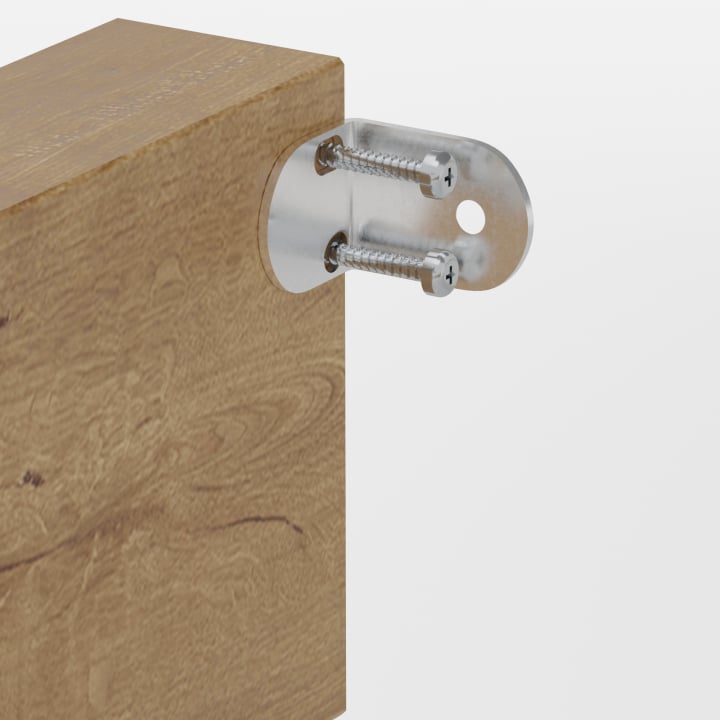
Fit the hardware into the checked points. On aluminium or metal rafters, pre-drill with 4.5 mm for the mounting bracket.
Tension
Tension a fixed tensioned sail diagonally until no fold remains. With a rope tension system, first set and tension all the ropes, then hang the sail.
Fixing a shade sail to a patio roof cover

Under a patio roof cover, a glass roof or a pergola, the rafters carry the load. The rope tension shade sail runs as one sail on two support ropes, the rope tension awning in panels, and both can be installed between or under the rafters. You fix a shade sail to an aluminium patio roof cover in the same way, only there you pre-drill with 4.5 mm. Instead of the wood screws from the set, stainless steel screws with a self-tapping point are available on request. How to measure there, how many drill holes are needed and what applies to timber and aluminium is explained under fixing a shade sail to rafters. The installation accessories come with every rope tension system; what is in the package is shown in setting up a shade sail.
Typical mistakes and what counts after installation
If you hang the sail or panel first on a rope tension system, you can hardly get the ropes taut afterwards. First set all the ropes and tension them firmly, then install. All the steps are shown in tensioning a shade sail.
A horizontally tensioned sail collects rain. If it is tensioned too flat, water pockets form. Allow for 25 to 30 cm per metre across the diagonal.
On a facade with thermal insulation, standard anchors hold only in the insulation layer. For head-on installation there are special ETICS anchors that pass the load into the masonry. In a rented flat, get the landlord's written consent first.
Rope tension shade sail and rope tension awning are sun protection, not a storm or rain roof. In rain, strong wind and storms you retract them and park the fabric bundle under the roof. You take a fixed tensioned sail down when a storm is forecast. More under shade sail in wind.
A fixed tensioned sail is not meant to be winter-proof. Take it down before the first autumn storm, let it dry and store it dry.
Order the right sail for your patio
We sew to your measurements in Westoverledingen. You can find ideas for shapes and colours on the patio under ideas for shade sails on the patio, and all other topics in the shade sail guide.
Shade sail with three or four corners
Triangle, square, rectangle or trapezoid, in fixed sizes or made to measure, also as a complete set with masts: made-to-measure shade sail.
Rope tension shade sail
Sliding on two support ropes, between or under the rafters or on the house wall, with complete installation accessories: made-to-measure rope tension shade sail.
Rope tension awning
In panels under a pergola or patio cover: made-to-measure rope tension awning.
On the balcony instead of the patio
Short spans, different points: fixing a shade sail on a balcony.
Frequently Asked Questions
Sources
Last reviewed: 22.10.2026 · Reviewer: Germes-Team
Not sure what will hold on your patio?
Send us a photo of your fixing points and the distances between them. We will tell you which type suits and how to fix it.