





Awning or shade sail
decide by roof, wind and rain
Awning or shade sail? Your roof gives the first answer: under a roofed structure a rope tension awning works, without a roof you tension a shade sail. After that, wind, rain and the question of whether you want to move the shade every day decide. Here you will find the limits we use to sort enquiries when advising.
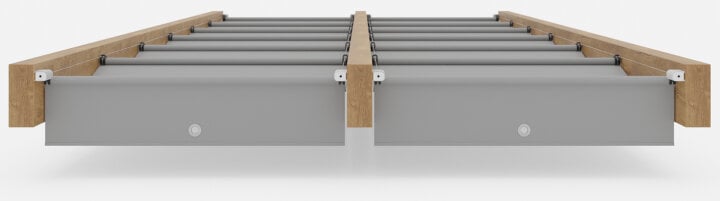
Whether an awning or a shade sail suits better comes down to three questions: is there a roof over the area, how windy is the spot, and should the shade be movable? This is how we sort enquiries when advising:
- With a roofed structure: the rope tension awning. The sewn-in aluminium tubes make it more stable and the look more even.
- Without a roofed structure: a rope tension shade sail or a fixed-tension shade sail. Both are lighter and less exposed to wind than an awning.
- Steep cross slope from about 45 degrees or an exposed location: the fixed-tension shade sail.
- Awnings and sails are sun protection, not a storm or rain roof. In rain, strong wind and storms you retract the moving systems.
Awning and shade sail compared
The details come from our production and from advice. We do not make articulated-arm or cassette awnings, so the table compares our rope tension awning with the two shade sails.
| Feature | Rope tension awning | Rope tension shade sail | Shade sail, fixed tension |
|---|---|---|---|
| Roof above | needed, runs between or under the rafters of a patio roof, pergola or glass roof | not needed, hangs from two support ropes between fixed points | not needed, tensioned between the house wall, posts or a mast |
| Operation | by hand with an operating pole, above about 3 m in height with a pull cord | push together and park | stays tensioned through the season |
| Wind | retract in strong wind and storms | lighter and less exposed to wind, but still retract in strong wind | copes with exposed locations too, take down in storms |
| Rain | retract, park the fabric bundle under the roof | retract and park under cover, otherwise take down | stays up, with a slope of 25 to 30 cm per metre rain runs off |
| Shape and size | rectangular bays, standard panels are about 150 cm; single panels we make up to 320 cm | rectangle, trapezoid and triangle to your measurements | triangle, quadrilateral, trapezoid or to your drawing |
| Look | sections with an aluminium tube every 38 to 41 cm | continuous sail, runner hooks every 20 or 30 cm | smoothly tensioned surface |
| Fabrics | Dralon, Polysun, Agora, Olefin | Dralon, Olefin | Agora, Olefin, waterproof cover |
| Guarantee on colour retention (colourfastness) | Agora 5 years, Polysun and Olefin 2 years | Olefin 2 years | Agora 5 years, Olefin 2 years |
When the awning is the better choice
The rope tension awning comes into its own when there is a roof and you often move the shade. These situations speak in its favour.
Patio roof, pergola or glass roof
The panels run on ropes between or under the rafters. Whether above or below the roof is better is explained in Sun protection above or below the patio roof.
Shade that changes every day
You push the panels open and closed from the ground, so the shade lies where you need it every day.
Wide bays
Wide panels get an extra rope guide in the middle. How many your panel needs is explained under Installing a rope tension awning. Standard panels are about 150 cm; single panels we make up to 320 cm.
Calm look
The aluminium tubes sit at even intervals. This looks uniform and keeps the panel stable, which is why we usually recommend the awning under a roof.
Awning on the house wall
We do not make articulated-arm or cassette awnings. You retract these in wind and rain too. What other options exist besides the awning is shown in Alternatives to the awning.
When the shade sail is the better choice
Without a roof, an awning is often not the right product. Then one of the two shade sails comes into question, depending on whether the shade should be movable.
Open patio without a roof
A fixed-tension shade sail hangs between the house wall, posts or a mast and stays up the whole season. Shapes, sizes and fabrics are listed under Shade sail made to measure.
Steep slope
From a cross slope of about 45 degrees there is no function guarantee for the rope tension awning, and the fixed sail is then the more stable solution. The degree limits are explained in Installing a rope tension awning.
Exposed location
The fixed-tension sail also covers windy spots and uneven areas where extendable systems are ruled out. If a storm is forecast, you still take it down.
Movable without a roof
The rope tension shade sail is a continuous sail on two support ropes that you push together. As a trapezoid, you can only push it from the wide to the narrow side. It does not replace a roof: before storms and bad weather you push it to a sheltered place, for example under a porch roof. If there is no room for this, take it down beforehand. Without a roof you use it at your own risk.
Awning or rope tension sail?
Both run on ropes but differ in construction. The guide Rope tension shade sail explains the exact difference.
Shade sail instead of an awning: what changes
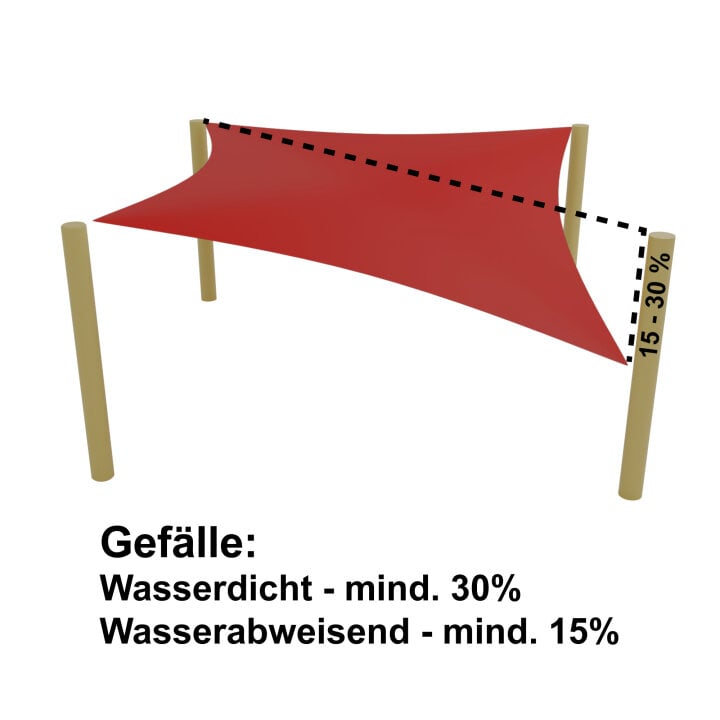
When replacing an old awning, many people wonder whether a shade sail instead of an awning is enough. A fixed-tension sail is considered more weather-resistant because it has no mechanism that wind can damage. It stays tensioned even when a shower comes. How much wind it can take is explained under Shade sails in wind.
- No extending and retracting: the sail stays at its points, and the shade is always in the same place.
- Allow for slope: one corner sits lower. With a slope of 25 to 30 cm per metre, rain runs off the water-repellent fabric.
- Load-bearing points: masonry, concrete or posts set in concrete. A gutter and a trellis do not hold the pull.
- Season: if a storm is forecast and before winter, you take the sail down and store it dry.
- Staying dry in rain: this only works with the waterproof cover version, which needs a consistent slope.
What awnings and shade sails cannot do
The rope tension awning and the rope tension shade sail are sun protection, not a storm or rain roof. In rain, strong wind and storms you push them together and park the fabric bundle under the roof. The roof itself provides the fixed weather protection.
Weather-resistant does not mean storm-proof. The force acts on the corners and their fixings, which is why you take the sail down when a storm is forecast.
Normal rain beads off Agora and Olefin, but with continuous rain water gets through. What the fabric can take in rain is explained under Leaving an awning out in the rain?
In a rented flat, get the landlord's written consent before any fixing to the facade or railing. This applies to awnings and shade sails alike.
What installation and ordering involve
We do not give prices here, because they depend on size and fabric. The configurator on each page calculates the price as soon as your measurements are set.
Drill holes for the awning
Between the rafters there are about twice as many drill holes as under them, see Attaching an awning to roof rafters.
Space for the fabric bundle
Pushed together, a typical rope tension awning needs about 30 to 35 cm of space under the roof. With longer and more panels the bundle gets bigger.
Points for the sail
A shade sail needs load-bearing anchor points. If they are missing, posts or masts are added, and that is the main effort with a sail.
Accessories in the package
The rope tension awning and the rope tension shade sail come with the complete mounting kit, and you only need the right anchor points.
See the fabric first
Free fabric samples show you colour and feel before you order.
More decision aids for your shade
Not sure whether awning or sail is even the question? These pages help with the neighbouring topics.
Frequently Asked Questions
Sources
- Sun protection guide
- Shade sail made to measure
- Rope tension awning made to measure
- Rope tension shade sail made to measure
Last reviewed: 09.11.2026 · Reviewer: Germes-Team
Not sure whether an awning or a sail suits your spot?
Send us a photo and the measurements of your area and tell us whether there is a roof above it. We will tell you which design suits and, if you wish, send fabric samples.