





DIY patio roof shading
what you do yourself and what we make
If you want to do the shading for your patio roof yourself, you do not have to sew. You measure, decide the fixing points and install it yourself, while we sew the fabric to your measurements and supply the installation accessories. Here you can see which four options there are, which work is yours and which is done by us in our workshop in Westoverledingen.

Doing patio shading yourself means in practice: measure and install it yourself, and have the fabric made to measure. This is how the work is divided:
- Under a patio roof or glass roof: a rope tension awning between or under the rafters, with you pushing the panels together by hand.
- Without a roof: a fixed-tension shade sail or a rope tension shade sail on ropes.
- Sun from the side: an outdoor curtain on wire rope or track.
- Your part: measure, decide the fixing points, drill and install. Our part: sew, insert tubes and eyelets, include the installation accessories.
- For every option: it is sun protection, not a rain roof. In rain, strong wind and storms, you retract the awning and rope tension sail.
Which patio sun protection you can install yourself
When you build patio sun protection yourself, you mainly do the fixing. All four options arrive ready-sewn to your measurements. Which one suits is decided mainly by whether there is already a roof over the patio.
What you do yourself
If you make the patio sun protection yourself, these jobs stay with you. You need no specialist knowledge for installation, but you do need experience with a drill and a ladder.
Measuring
For the rope tension awning, you state the width as the clear dimension between the rafters, and the length including the rope tensioning device. How to do this step by step is explained at How to measure a rope tension awning.
Deciding the fixing points
The fixing sits on rafters, fascia board, posts or house wall and must hold the tension permanently. Whether to install above or below the roof is covered at Sun protection above or below the patio roof.
Installing
With the rope tension awning, you first fit and tension the ropes of each rope guide, and only then hang the panel. Installing a rope tension awning shows every step with pictures.
Hanging the curtain yourself
The outdoor curtain hangs from wire rope or track, which you fix to posts, beams or the wall. The steps are in the installation guide for the outdoor curtain.
What production takes care of
Whatever needs a lot of machinery and practice, we do in our sewing workshop in Westoverledingen, always to your measurements.
Sewing and making up
We cut the fabric, sew hems and pockets and, with the rope tension awning, insert the aluminium tubes concealed in the pockets.
Eyelets and loops
On the fixed-tension shade sail, we fit eyelets and loops as your drawing specifies. On the outdoor curtain, the hanging for rope or track comes attached to the fabric.
Installation accessories
We include rope tensioners, sliders, rope and stoppers to suit the system. You do not have to collect anything separately.
Would you rather sew it yourself?
That is possible, but it needs exactly cut tubes and even pockets. All the measurements for this are at Making a rope tension awning yourself.
What is supplied, in brief
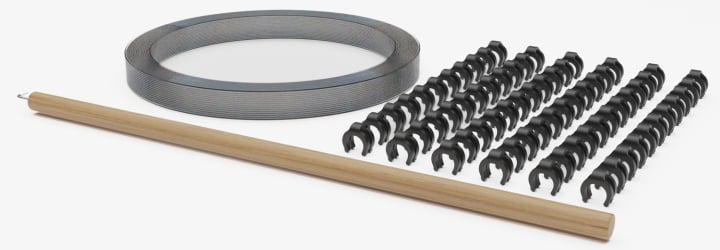
With the sliding options, the complete installation accessories are included. What you have to prepare yourself is manageable:
- Rope tension awning: panels with aluminium tubes, rope tensioners, sliders, polyester rope, stoppers, operating pole and a GERMES tool set.
- Rope tension shade sail: sail, rope tensioners, rope and sliding hooks.
- We only supply stainless steel rope by arrangement, for example from a length of around 6.5 m.
- We send the installation guide digitally as a PDF with the order confirmation or the invoice.
- Have ready yourself: a drill and screwdriver or cordless screwdriver, plus a safe ladder.
So that the fixing holds
Whether DIY patio sun protection holds is decided by the fixing, not the fabric. We clarify these points first in the consultation.
Does the structure bear the load?
Thin sheet metal, home-made structures or unclear brackets are hard to judge from a distance. In that case, we can make a single panel first on request, which you test at your own risk. If the fixing holds, the remaining panels follow.
Dimensions only measurable after installation
For a pergola or steel structure without a fascia board, we send the installation material in advance. You fit the brackets, measure the real panel sizes, and only then do we sew the fabric.
Surface and tools
Timber, metal, house wall: which fixing suits which surface is explained at Installing an awning yourself.
Rented flat
Before you drill into the façade, rafters or railing, ask your landlord and get consent in writing.
Not a rain roof
You push the rope tension awning and rope tension shade sail together in rain, strong wind and storms. With no roof over the area, a shade sail is more likely to suit, and more on this is at Awning or shade sail.
Still looking for the idea?
Which shading suits which patio, with and without a roof, is collected at Sun protection ideas for the patio.
Making balcony sun protection yourself
On the balcony too, you measure and fix it yourself, and we sew the balcony screen with eyelets to measure. How to measure it correctly and fit it to the railing is explained at Making a balcony privacy screen yourself.
Frequently Asked Questions
Sources
- Sun protection for the patio
- Made-to-measure rope tension awning
- Installing a rope tension awning
- Sun protection guide
Last reviewed: 09.11.2026 · Reviewer: Germes-Team
Install it yourself, made to measure
Send us a photo of your patio and the measurements, and tell us whether there is a roof over it. We will tell you which option suits and, if you like, send fabric samples.