





What is inside an outdoor cushion?
Foam core, density rating and thermal fleece explained
Under every cover sits a foam core, and that core decides whether a cushion still holds its shape after three summers. Two figures describe it: the density rating and the compression hardness. This page explains what those numbers actually mean, which filling we use where, and how to tell good cushion filling from poor.
Three layers, that is all there is
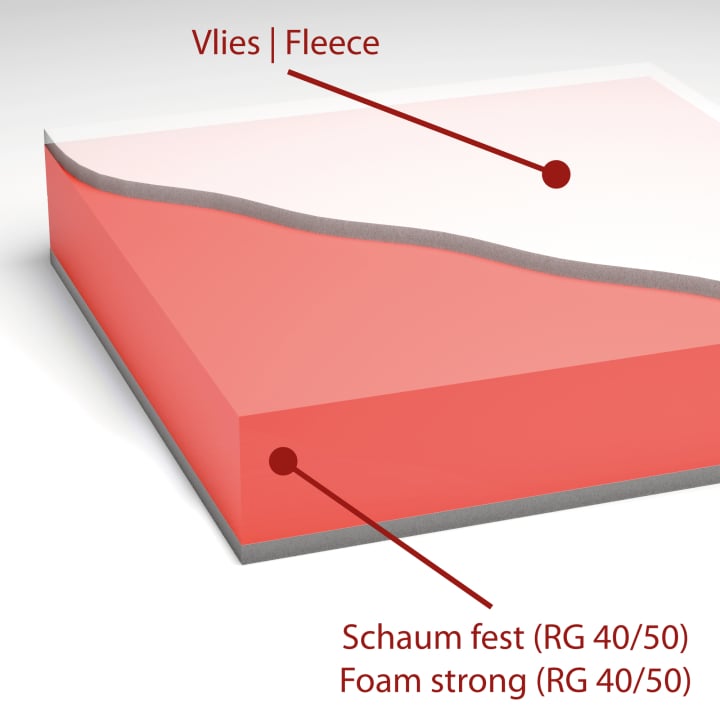
An outdoor cushion is a foam core, a wrap of thermal fleece and the cover over the top. The foam core carries the load and holds the shape. The thermal fleece rounds off the hard foam edges, softens the surface and works much like a topper on a mattress. It also reflects warmth back, which is noticeable on cooler evenings outdoors. Our upholstery foam and the fleece are certified to OEKO-TEX Standard 100 and additionally tested for harmful substances.
The two foam grades and what their numbers mean
We work with two grades of upholstery foam. Which one goes in depends on whether the surface has to carry weight or to lean against. The figure before the slash is the foam density, the one after it the compression hardness.
| Property | Firm foam RG 40/50 | Soft foam RG 20/30 |
|---|---|---|
| Typical use | seat surfaces, bench cushions, commercial use | back and wall cushions, soft indoor seat cushions |
| Foam density | 40 kg of material per cubic metre | 20 kg of material per cubic metre |
| Compression hardness | 50, clear resistance to pressure | 30, yields sooner |
| How it feels | carries you, does not bottom out | soft, comfortable to lean into |
| Why this choice | the surface has to stay stable under body weight | a back rest should not feel firm |
How the core is layered
Not every cushion gets a single block of foam. Depending on the product and the thickness ordered we combine firm and soft layers. All three versions then go through the same wrap of thermal fleece.
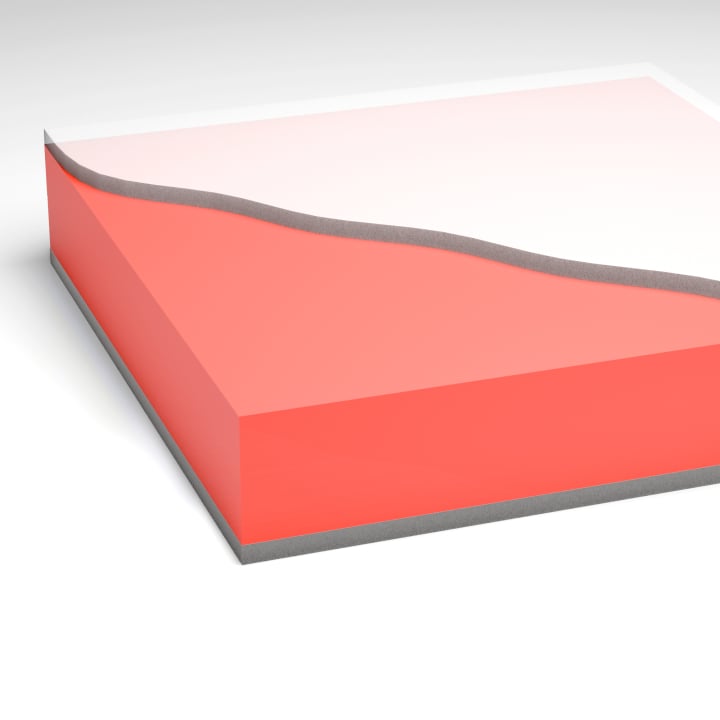
The standard build for seat surfaces. One block of firm foam, wrapped all round in thermal fleece.
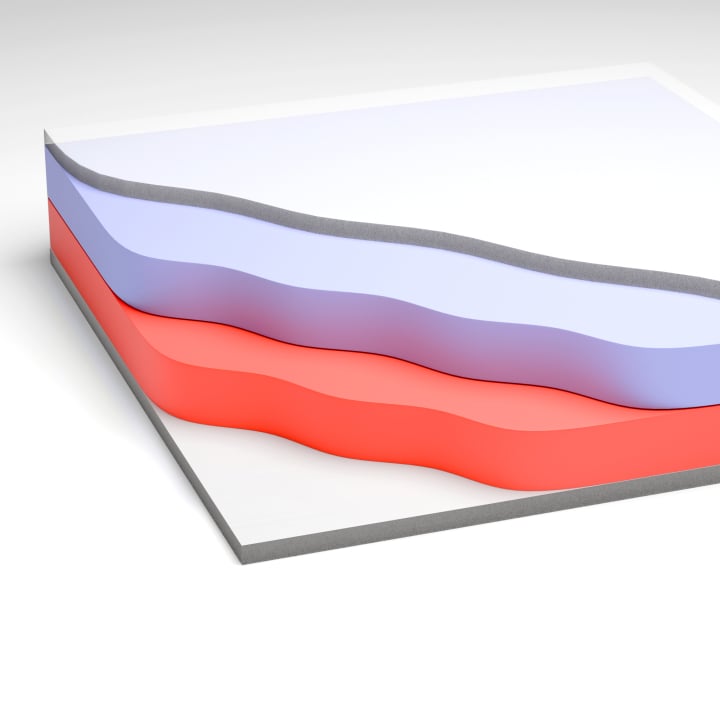
A soft layer sits on the firm core. That gives a kinder first impression as you sit down, without the surface bottoming out.
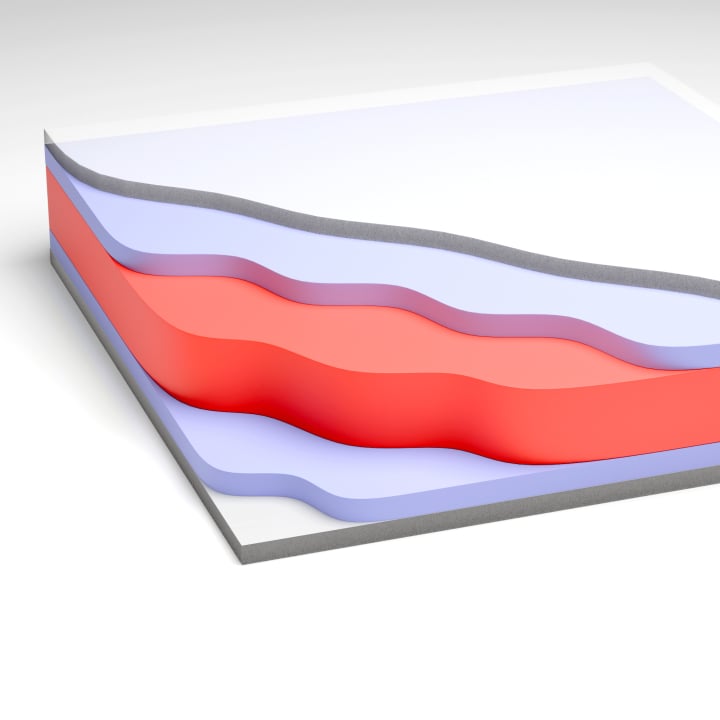
The firm core sits between two soft layers. The cushion can be turned over and feels the same from either side.
The thicknesses we hold
Foam sheets reach us at 240 cm long and are cut to size in our own workshop. The foam core follows a fixed grid of thicknesses. Multi-layer cores are bonded, using a solvent-free, water-based dispersion adhesive.
| Component | Available thicknesses | Note |
|---|---|---|
| Foam core | 4 to 20 cm, always in steps of 2 cm | so 4, 6, 8, 10, 12, 14, 16, 18 and 20 cm, for seat and back cushions alike |
| Odd thicknesses | outside the grid | 5, 7 or 9 cm cannot be produced as a foam sheet |
| Thermal fleece wrap | 0.5 / 1.5 / 2.5 cm | the thickness follows the product |
| Fine tuning in between | through extra fleece layers | this brings an intermediate height within reach |
| Outside the grid | below 4 cm and above 20 cm on request | the configurator shows 4 to 20 cm, special thicknesses we take directly |
Offcuts go back in as filling
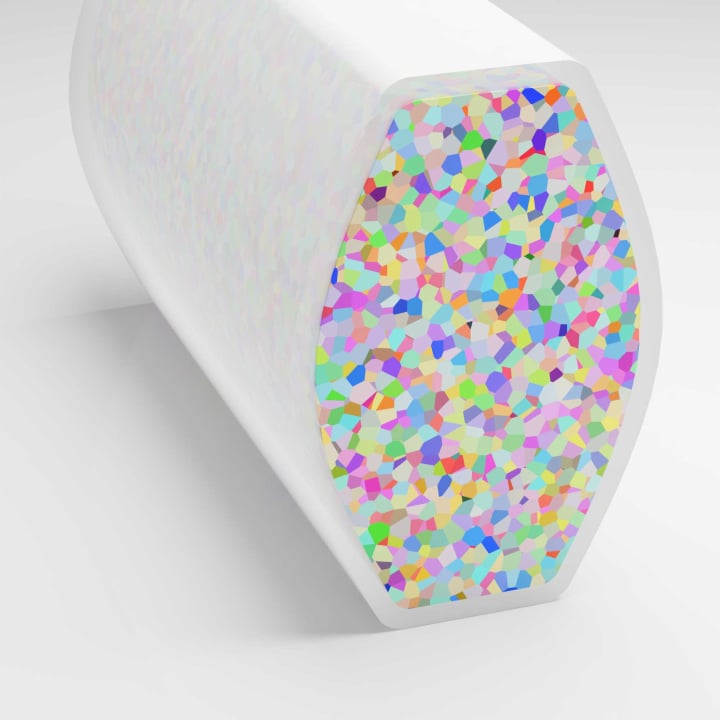
Cutting foam to size leaves offcuts. Rather than dispose of them, a machine of our own shreds the remnants into flakes, and the fleece offcuts go in with them. That filling goes into our Flop cushions, whose loose flake filling adapts to the shape of the body as you sit down. The waste from cushion production becomes a product instead of rubbish.
Three mistakes people make about foam
This is the most common mix-up. The density rating says how much material sits in a cubic metre of foam, which makes it a measure of durability and shape retention. How firm the foam feels is told by the compression hardness alone. A foam can be heavy and still be soft. Reading only one of the two numbers means buying past your needs.
The cover does, provided the cushion has a zip, and then according to the care instructions for that fabric. The foam core itself must not go in, the machine tears its structure apart. If the foam has got wet, stand it at an angle against a wall and let it dry right through before it goes back in the cover.
Whether a cushion feels good comes from the combination of compression hardness and fleece layer, not from the number of centimetres on its own. Two seating feels can be built from the same firm foam: a 10 cm core with 0.5 cm of fleece each side feels taut, while an 8 cm core with 1.5 cm each side comes to the same total height and feels noticeably softer. And because our foams compress very little, the thickness adds almost fully to the seat height. On chairs around 50 cm seat height it is worth asking first whether your feet will still reach the floor comfortably.
Frequently Asked Questions
Sources
- Custom cushions made to measure
- Cushion seam types explained
- Care guide for outdoor cushions
- All terms in the glossary
Last reviewed: 21.08.2026 · Reviewer: Germes-Team
Not sure which foam suits your furniture?
Tell us what the piece of furniture is and how the cushion will be used. We will tell you which grade and which thickness make sense for it.