





Shade Sails in Wind
what holds, what comes down
Whether a shade sail may stay up in wind depends on its design. A fixed, tensioned sail withstands a fresh breeze, while a rope tension awning or a rope tension shade sail is retracted in strong wind already. Here you can read what applies to which system and what to do before a storm.
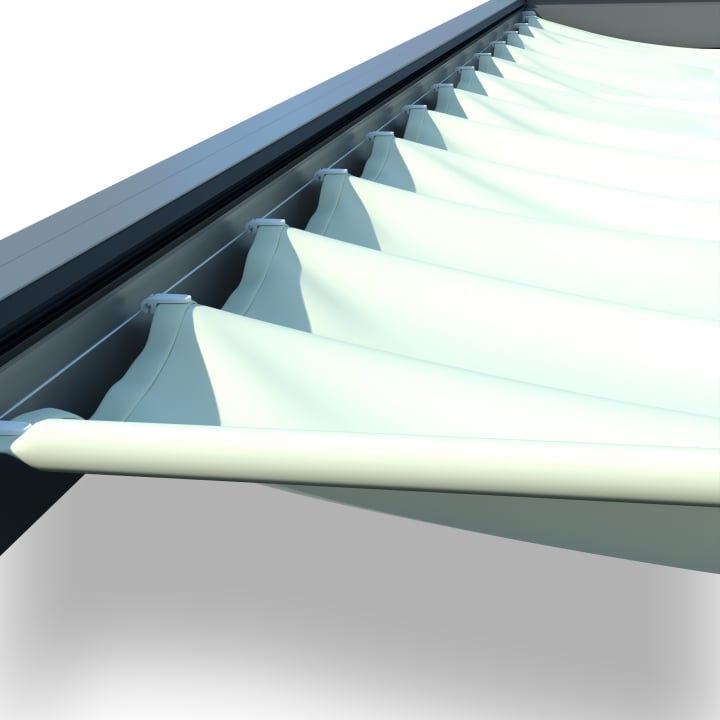
A shade sail gives shade, but it is not a storm or rain roof. How much wind it can take depends on the design: you retract movable systems early, and you take a fixed, tensioned sail down before a storm at the latest.
- The rope tension awning and rope tension shade sail are not wind protection: retract them in strong wind, storms and rain, and park the fabric bundle under cover.
- A fixed, tensioned shade sail is weather-resistant and also covers exposed spots. It is still not storm-proof, though: take it down when a storm is forecast.
- On the folding shade sail, individual connections can tear out of the screw fixing in exceptionally strong gusts. We send small parts free of charge for an existing order.
- Freely hanging rope systems without rafters are more sensitive to wind than an awning between the rafters.
- We do not state a fixed limit in km/h. What decides it is the design, the fixing and the location. If in doubt, retract or take it down earlier rather than later.
How Much Wind Can a Shade Sail Take?
The term "shade sail" covers systems with very different mechanics. That is why there is no single rule for all of them. First assign your sail to a design, and then the matching rule applies.
Rope tension awning
The panels run on ropes between the rafters. The awning is pure sun protection and has to be installed and used sheltered from wind and weather. In rain, strong wind or storms, you retract it and park the fabric bundle under the roof.
Rope tension shade sail
It slides on two support ropes and can be pushed to the side. The same rule applies to wind as for the awning: it is not weatherproof shading and is retracted in rain, strong wind and storms. The parking position should be under cover.
Folding shade sail
The folding shade sail is also built to be retracted. In exceptionally strong gusts, it cannot be entirely ruled out that individual connections tear out of the screw fixing. With fresh material, this is easily renewed.
Fixed, tensioned shade sail
It is installed once and stays at its points for the season. Thanks to its flexible shape, it also covers steep slopes and exposed spots where an awning no longer works. Weather-resistant does not mean storm-proof, though: the force acts on the corners and their fixings.
Freely hanging span
For long spans of around 6 to 10 m without rafters, there is a special solution with stainless steel wire rope and eye bolts. Without a rigid structure, the fabric is more exposed to the wind, and in wind or rain it is retracted or relieved of load.
No figure in km/h
We do not state a wind strength above which every sail has to come down. Area, location and fixing points make too much difference. Stick to the rule for your design and to the storm warning.
Leave the Shade Sail Up in Wind?
A fixed, tensioned shade sail stays up, as it is made for that. With a movable system, it is enough to keep an eye on the weather as long as no strong wind is forecast.
You retract the rope tension awning, the rope tension shade sail and the folding shade sail. The fabric bundle belongs in a sheltered parking position. On the rope tension awning, the retracted bundle needs about 30 to 35 cm of depth.
Now the fixed, tensioned sail has to come down as well. How to go about it is explained in the next section. The guide Tensioning a shade sail helps when you hang it up again.
If a rope tension awning is to park under its own canopy, the protection depth calculator on the page Made-to-measure rope tension awning works out the depth needed.
Storm Forecast - What to Do
Identify the design
Movable system or fixed, tensioned sail? This decides whether you retract or take it down.
Retract movable systems
Push the panels or sail together and park the fabric bundle under cover. This protects the fabric and the ropes.
Take down fixed sails
Loosen the turnbuckles and unhook the carabiners from the stainless steel rings at the corners.
Dry and store
Let wet sails air-dry for a day. Then store them dry and well ventilated, not directly on bare concrete.
Check after the storm
Look at the corners, carabiners and screw fixings. Only when everything is firm, tension the sail diagonally again.
What About Rain or Winter?
Wind is not the only weather you have to act on. Here is the short version, and the full details are under Waterproofing a shade sail and winterising it.
In rain
You retract movable systems in rain just as you do in strong wind. A fixed, tensioned sail may stay up if it has a slope of 25 to 30 cm per metre. Normal rain runs off water-repellent Agora, but in prolonged or heavy rain, water gets through.
In winter
Over winter, you take every sail down, even a waterproof one. Snow load and autumn storms put more strain on the seams and anchoring than the whole summer.
Which Shade Sail for Windy Spots?
If your patio is open to the wind, choosing the system is worthwhile before you buy. Which points can hold the tension is explained under Fixing a shade sail.
Exposed spot
Here the fixed, tensioned shade sail is the reliable choice. It needs no rope guides and stays permanently installed. On steeply sloping areas, too, the fixed, tensioned sail is the reliable choice, and a rope tension awning reaches its limits there, see Installing a rope tension awning.
Without a roof
If there is no roof over the area, an awning is often not the right product. Then choose a rope tension shade sail or another lighter solution that is less prone to wind. It too is retracted in rain, strong wind and storms and parked under cover.
The corner takes the wind
For stability in wind, the corner counts. Instead of punched eyelets, our sails have a stainless steel fixing ring there, and the webbing at the edge takes up the tension.
Load-bearing points
Brickwork, concrete and a post in a pad foundation hold the tension. A gutter and a trellis do not. On a balcony, there are ways that do not touch the facade, see Shade sail on a balcony without drilling.
Fabric for outdoors
We sew the fixed, tensioned sail from Agora, from Olefin or in the waterproof Cover version. Olefin is lightfast, water-repellent and suitable for exposed spots, and for sails made to your drawing it is our standard.
The Right System for Your Location
We sew to your measurements in Westoverledingen. You can find all further topics about sails in the Shade Sail Guide.
Fixed, tensioned shade sail
Triangle, square, rectangle or trapezium, water-repellent or waterproof: Made-to-measure shade sails.
Rope tension shade sail
Sliding on two support ropes, quickly retracted in wind: Made-to-measure rope tension shade sail.
Rope tension awning
In panels under a pergola or patio roof, with a protection depth calculator for the parking position: Made-to-measure rope tension awning.
Folding shade sail
For panels up to 150 cm wide: Made-to-measure folding shade sail.
Frequently Asked Questions
Sources
Last reviewed: 23.10.2026 · Reviewer: Germes-Team
Not Sure Whether Your Spot Is Too Windy?
Send us a photo, the measurements and a short description of the location. We will tell you which system will hold there and when you should retract it.