





Weighting an outdoor curtain
with lead weight tape and eyelets at the bottom
You weight an outdoor curtain with a lead weight tape in the bottom hem. So that it does not blow up in the wind, eyelets at the bottom also hold it to a ground anchor, stone or railing. Here you can read how to plan the bottom hem, what to fix it to, how much clearance to leave above the floor and where the limit lies.
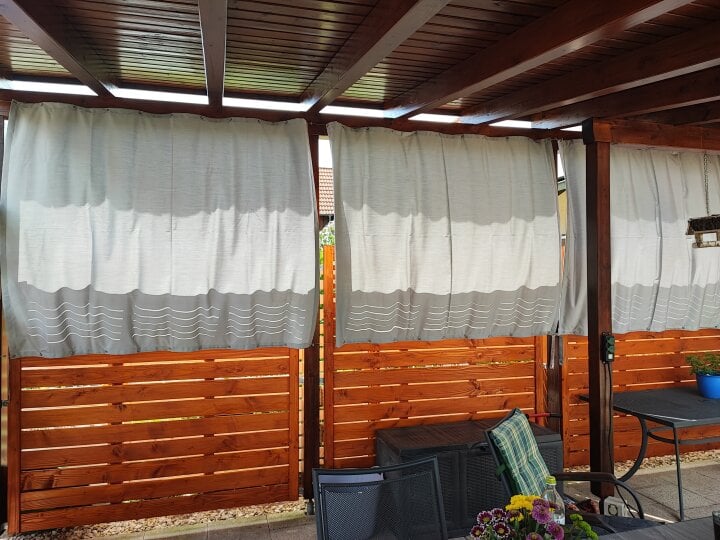
An outdoor curtain hangs from a wire rope or rail at the top. At the bottom it is free, and that is exactly where the wind takes hold. Two things in the bottom hem keep it steady:
- Lead weight tape: it sits in the bottom hem and spreads weight across the whole width. The curtain hangs straight and flaps less.
- Eyelets at the bottom: you use them to tie the curtain to a ground anchor, weighting stone, railing or a tensioning rope. One eyelet every 50 to 100 cm is typical, and you decide the number and position.
- Floor clearance: the curtain ends just above the floor, as a rule of thumb 15 to 25 mm. It never rests on the floor, otherwise the hem wears through.
- Limit: weighting helps against normal wind. The curtain is not storm protection, and in a storm you take it down.
Lead weight tape in the bottom hem
The lead weight tape is the actual curtain weight. It is sewn into the bottom hem during production. So you choose it when you place the order.
Weight across the whole width
The tape runs through the hem from edge to edge. This pulls the fabric down evenly, without loading individual points. Our standard is a lead weight tape of 70 to 85 g per metre, which is enough for most situations.
Corner eyelets as well
Outdoors, the bottom hem usually also gets eyelets in the two corners. They let you fasten the weighted curtain at the bottom.
Always straight at the bottom
Even a curtain for a sloping pergola or pitched roof is straight at the bottom. Only the top hem follows the slope, because lead weight tape and corner eyelets need a straight hem. The curtain therefore becomes trapezoidal, for example with the outdoor curtain for a pitched roof.
Net curtains indoors
A net curtain indoors is weighted in the same way. Outdoors the wind comes into play, which is why lead weight tape is standard for the outdoor curtain.
Eyelets at the bottom and what to fasten them to
Lead weight tape alone does not keep a curtain in place when gusts come from the side. That is what the eyelets in the bottom hem are for. They only make sense if you also fasten them to something, otherwise they spoil the look.
Ground anchor or hook
A screw hook or ground anchor in the patio floor holds the eyelet. It is drilled or screwed in. If you rent, ask the landlord beforehand.
Weighting stone
A heavy stone or planter that you tie the eyelet to needs no drill hole. Which solutions work on a balcony with no drilling at all is shown in curtain on the balcony without drilling.
Railing or tensioning rope
If there is a railing or parapet at the bottom, tie the eyelets to it or hook them in with carabiners. In a very windy spot, the bottom hem can also run on a second rope, guided at the top and bottom.
You decide the number
How many eyelets the bottom hem gets and where they sit is something you specify when ordering. One eyelet every 50 to 100 cm is typical, depending on the location. You get the anchors, hooks and stones yourself, and we supply the curtain with eyelets and lead weight tape.
Knot or carabiner
Why a carabiner spares the fabric and a tight knot strains it is explained in carabiner instead of knot.
Weighting the curtain and fixing it at the bottom in four steps
Finish mounting at the top
First fit the eye bolts and wire rope or the rail. Measure the curtain height only afterwards, because dimensions estimated in advance often differ by 5 to 15 cm on the rope.
Choose the bottom hem
Choose the bottom hem with lead weight tape, with lead weight tape and corner eyelets, or with further eyelets at the bottom. Plan for 15 to 25 mm of clearance above the floor.
Create fixing points at the bottom
Put a ground anchor or screw hook under each eyelet, place a weighting stone or use the railing. The points sit vertically below the eyelets.
Hook in, tie down, check
Hook the curtain in at the top and tie the eyelets down at the bottom. Close it fully once and check that the hem touches the floor nowhere.
Floor clearance and hem abrasion
The most common damage to an outdoor curtain happens at the bottom: the hem rubs on the floor, tears open after one or two seasons and the lead weight tape shows. This is usually not a fault of the fabric or seam, but a result of floor contact.
Just above the floor
Let the curtain end 15 to 25 mm above the floor. If it touches the floor when closed, shortening it is the lasting solution.
Keep the rope taut
If the wire rope sags in the middle, the hem sinks too. Re-tighten the tensioner after winter and with temperature changes. How to do this is covered under tensioning wire rope.
To the side when not in use
Push the curtain to the house wall and tie it there. This keeps the hem out of the zone where it rubs or stands in splashing water.
Already torn
If the hem has torn, we shorten the curtain in height: the damaged part is cut off and the hem is sewn again. We quote the cost after seeing a photo.
What weighting does not do
Unlike an awning or a shade sail, the curtain hangs vertically and catches the wind with its whole surface. Lead weight tape and eyelets make it steadier, but they do not make it storm-proof.
Take it down in a storm
Textile privacy and sun protection is not storm protection. How to protect a patio and balcony in wind and in winter is covered under wind protection for the patio.
Windy location
If the curtain stands strongly in the wind, the rail with a lock is the more reliable suspension. On a wire rope, eyelets and carabiners can slip over the stopper in a storm.
Winter
The bottom fixing cannot take a load of ice and snow. Take the curtain down in winter and store it dry.
Curtain without a roof
Without a roof, a large curtain gets wet and heavy in lasting rain. What this means for the suspension and construction is covered under fixing a privacy screen on the patio.
Lead weight tape and eyelets right at production
If you want to weight your outdoor curtains, this can already be done in the workshop: we sew in lead weight tape, corner eyelets and further eyelets at the bottom in Westoverledingen according to your details, Made in Germany. You put together fabric, hems and suspension with the made-to-measure outdoor curtain.
Mount at the top
How to mount the wire rope or rail and hook in the curtain is shown in the installation instructions for outdoor curtains.
Care
How to clean the fabric before storing it is covered in the care instructions for outdoor curtains.
Send a photo
Not sure how many eyelets make sense at the bottom? Send us a photo and the dimensions via the service centre.
More sun protection
Shade from above, balcony and pergola: you will find all topics around sun protection in the sun protection guide.
Frequently Asked Questions
Sources
Last reviewed: 09.11.2026 · Reviewer: Germes-Team
Questions about the bottom hem?
Send us a photo of the spot and the dimensions. We will tell you whether lead weight tape is enough and how many eyelets make sense at the bottom.