





Tensioning a wire rope
with eye bolts, turnbuckle and clamp
You tension a wire rope between two fixed points: an eye bolt or bracket at each end, a turnbuckle on one side and a clamp at the end of the rope. Here you can read which rope suits, what length to order, in which order to tension and what helps if the rope sags. You tension a steel rope in exactly the same way.
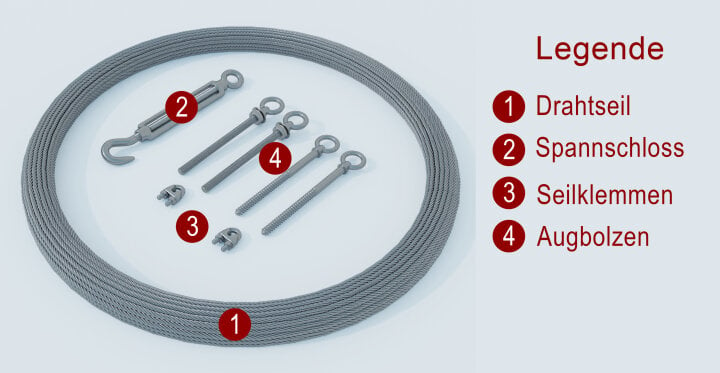
This is how you can tension a wire rope properly, whether for the rope tension awning, the rope tension shade sail or the curtain. The order is always the same.
- Order: first clamp and align, then cut off. The steps are in the instructions below.
- Length: for the rope tension awning, you state the length including the rope tensioning device. We supply the tension ropes with a reserve for clamping and tensioning.
- Material: polyester rope with 1,800 N tensile load is standard for the rope tension awning. We only supply stainless steel rope by arrangement, for example from a length of around 6.5 m.
- Sagging: a centre bolt, all the rope guides or stainless steel rope help, more under Fixing a sagging rope.
Polyester or stainless steel
Which rope suits depends on the length and the load. As the length grows, so do the rope's own weight, the fabric weight and the wind load on the rope.
| Feature | Polyester rope | Stainless steel rope |
|---|---|---|
| Typical use | Rope tension awning and rope tension shade sail | long spans and especially taut tension |
| Length | usual sizes | recommended from around 6.5 m |
| Properties | Tensile load 1,800 N, UV-resistant, maintenance-free | rustproof, dimensionally stable, can be tensioned more tightly |
| Ordering | Standard, included in the configurator | only by arrangement, not selectable in the configurator |
Which rope length to state
A rope cut exactly to size cannot be pulled taut any more. The turnbuckle needs travel, and eye bolts and clamps need space.
Measure the clear distance
Measure the clear distance between the two fixing points, in other words from beam to beam or from post to wall. You state this figure when you order.
The reserve is already included
For the rope tension awning, we supply the tension ropes with a reserve for clamping and tensioning. Do not add an allowance yourself.
Rope for the curtain
With the outdoor curtain, the eye bolts and turnbuckle are part of the span. What you state for this is explained at Attaching a privacy screen on the patio.
Tensioning a wire rope step by step
Set the fixing points
Fit an eye bolt or bracket at both ends. In timber and metal it is screwed in, and in masonry it goes in with a plug. First check that there are no cables in the wall and that the posts or beams can bear the tension.
Unscrew the turnbuckle fully
Unscrew the turnbuckle fully on one side and hook it in. This leaves you the full travel for retensioning.
Clamp the rope on one side
On the first side, pass the rope through the eye bolt or stop element and fix it with the clamp or the grub screws.
Align and cut the other side
Pull the rope to the other side and align it, with the rope clamp, at the turnbuckle. Only now do you cut off the excess. This way the rope is never too short.
Tension
Turn the turnbuckle closed until the rope is taut. Do not tension too much, so that the beams and eye bolts are not damaged. Use the thread fully on both sides.
Check the sag
If the rope sags in the middle, add another eye bolt in the middle for a curtain rope over a 200 cm span. For the awning, first tension all the ropes and then hang the panel.
Fixing a sagging rope
A slight sag is normal with every tensioned rope. If it gets too big, it is usually down to one of these points.
Centre bolt from 200 cm
With wire rope for the curtain, add an eye bolt in the middle of the bay over a 200 cm span. Wide bays therefore get a split curtain, and the bolt then sits at the join of the two halves.
Use all the rope guides
With the rope tension awning, the number of rope guides depends on the panel width, and the scale is at Installing a rope tension awning. If one is missing, the panel sags.
Ropes first, then the panel
First tension all the ropes firmly and then fit the panel. The other way round, you can hardly get the ropes taut any more.
Stainless steel instead of polyester
If it still sags, stainless steel rope can be tensioned more tightly than polyester rope. Stainless steel rope is not selectable in the configurator, and you only get it by arrangement with us.
Long open spans
Over 6 to 10 m with no rafters in between, a free rope visibly sags more than an awning between rafters. We plan solutions like this case by case, with photos and measurements from you.
Where to tension a wire rope
The rope is only as good as the points it hangs from. An eye bolt always needs a drill hole.
Between two posts
If you tension a wire rope between two posts, the eye bolt is drilled through the post material. The posts must stand firm and withstand the tension permanently, and this also applies to a wire rope in the garden.
On the house wall
On the house wall, the eye bolt sits in the masonry with a plug. On an insulated façade, special ETICS plugs are needed that carry the load through to the load-bearing masonry.
Under rafters and pergola
Under the patio roof or on the pergola, the rope tensioners sit between or under the rafters, and on aluminium and metal directly on the profile. How the awning goes in there is shown in the installation of the rope tension awning.
Wire rope on a balcony
A wire rope on a balcony also needs drill holes. If you rent, ask the landlord in writing beforehand. What holds without drilling is sorted out at Sun protection on the balcony without drilling, and for the curtain there is Curtain on the balcony without drilling.
Rope and accessories for your sun protection
You can get ropes, turnbuckles and eye bolts as ready-made sets in your length. You will find all the parts for rope and track in the sun protection accessories.
Wire rope for the curtain
The wire rope system for outdoor curtains consists of stainless steel wire rope with a diameter of 2 mm, two U-bolt rope clamps, a turnbuckle and eye bolts. You choose the rope length between 100 and 1,500 cm, and over 2 m intermediate bolts are included.
Hanging the curtain
Once the rope is tensioned, the curtain hangs from carabiners in the top hem. The installation guide for outdoor curtains shows the installation step by step. Why carabiners rather than knots is explained at Carabiners instead of knots, and how to hold the curtain down at the bottom at Weighting an outdoor curtain.
Rope for the awning
The rope tension awning runs on tensioned ropes under the roof. Replacements are available as polyester rope, plus sliders and the operating pole for extending it.
Shade sail on ropes
Without a roof, the rope carries the load alone. The rope tension shade sail also runs on polyester rope as standard, and stainless steel rope is available by arrangement. The sun protection guide shows more ways to shade and sun protection.
Frequently Asked Questions
Sources
- Sun protection accessories for rope and track
- Wire rope system for outdoor curtains
- Installation guide for outdoor curtains
- Installation of the rope tension awning
Last reviewed: 09.11.2026 · Reviewer: Germes-Team
Questions about rope and turnbuckle?
Send us a photo of the fixing points and the measurements. We will tell you which rope suits and which length to state.