





Sun protection over or under a patio roof?
what suits when
Whether sun protection works better over or under the patio roof depends on three things: the weather, the heat under the glass and what you can fix it to. We make made-to-measure textile sun protection for fitting under the roof. Here you can read how the two approaches differ, when each one suits and how to reach the right solution for your patio step by step.
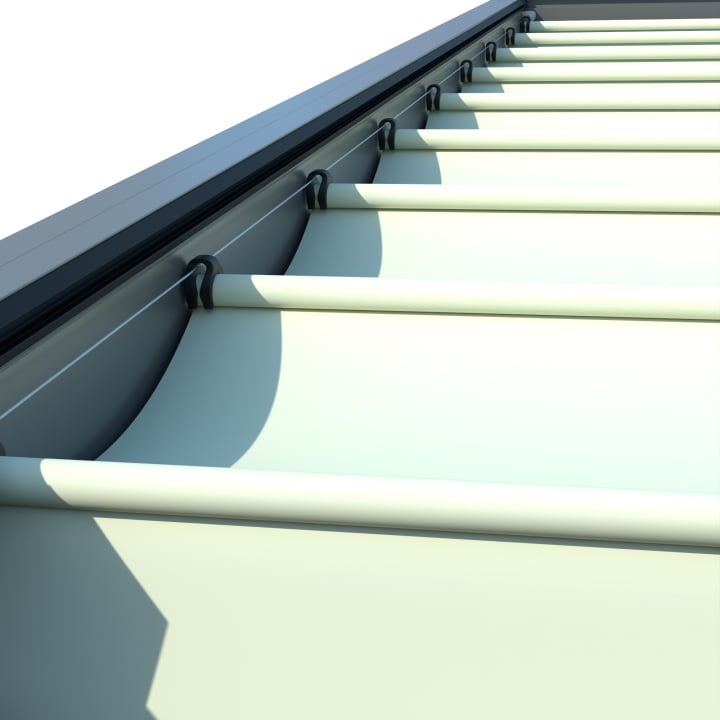
For most patios with a solid roof, sun protection under the roof is the simpler choice: it stays sheltered and can be fitted afterwards. A system over the roof, by contrast, sits fully exposed to the weather. The decision in three points:
- Under the roof: a rope tension awning or a folding awning runs between or under the rafters. The retracted fabric bundle is parked under the roof, out of the weather.
- Over the roof: on-roof systems lie on the outside of the glass and stand in wind and rain. We do not make such systems. Textile sun protection is not weather protection and does not belong out in the open on the roof.
- Heat: under the roof the sun first passes through the glass, and some of the heat stays under the roof. A dense, opaque fabric keeps out more heat than a semi-transparent one.
Over or under the patio roof compared
The column for under the roof describes our rope tension awning and folding awning. For systems over the roof we only name general features, because we do not make them.
| Feature | Under the roof | Over the roof |
|---|---|---|
| Where it goes | between or under the rafters of a glass or plastic roof, pergola or conservatory | on the outside of the glass roof |
| Weather | sheltered by the roof, retract in rain, strong wind and storms | fully exposed to wind and rain |
| Heat | sun comes through the glass, heat builds up under the roof | catches the sun before it reaches the glass |
| Installation | between or under the rafters, on wood or metal | on the roof, effort depends on the system |
| Operation | by hand with an operating pole, from a height of about 3 m a pulley rope system | usually motorised |
| Panel width | folding awning up to 1.50 m, rope tension awning under 1.45 m recommended per rafter bay | no information |
| Fabrics | rope tension awning with Dralon, Polysun, Agora or Olefin | no information |
| Warranty | Agora 5 years, Polysun and Olefin 2 years warranty on colour fastness | no information |
When sun protection under the roof is the right choice
Under the roof is the rule as soon as your patio roof, pergola or conservatory has a solid roof. The fabric then hangs in the shelter, and you can also fit it later. These limits help with your choice:
Rafter bay under 1.45 m
Under 1.45 m panel width, both the folding awning and the rope tension awning fit. The made-to-measure folding awning runs in tracks with hook-and-loop profiles and gives a calm look.
Rafter bay from 1.45 m
From 1.45 m, a rope tension awning panel needs a third cable guide in the middle. Between the rafters there is usually no fixing point for it, so we recommend panels under 1.45 m there. The folding awning runs in tracks and goes up to 1.50 m. If your rafter bay is wider, we are happy to advise you.
Large area, several panels
A whole pergola or patio cannot be shaded with a single panel. The area is divided into parallel panels, which you extend and retract one by one.
Glass roof and dark colours
Under glass the UV load is higher, and there is no wind to cool the fabric. For dark shades we recommend a solution-dyed fabric there: Agora with a 5-year or Polysun with a 2-year warranty on colour fastness.
High roof
The operating pole reaches up to about 3 m. If the awning sits higher, for example under a conservatory roof, you move the panel from the ground with a pulley rope system. There is no motor for the rope tension awning.
Sloping roof
On sloping roofs the fabric bundle parks at the highest point, and a stopper on the first aluminium tube holds it there. For what applies to a cross slope, read fitting a rope tension awning.
When the question of a system over the roof arises
Sun protection over the roof has one advantage: it keeps the sun away from the glass. In return, it stands in every kind of weather. Fabric pergola sun protection is not built for that.
On-roof systems are separate installations
On-roof systems lie on the outside of the glass and are built for wind and rain. We do not make such installations and do not give a buying recommendation for them. Which types of roof exist for pergolas and covered patios is shown in What do you call a pergola with a roof?
Fabric does not belong in the open on the roof
The rope tension awning and the rope tension shade sail are pure sun protection, not wind or weather protection. They must be fitted sheltered from wind and weather, and the fabric bundle parks under a solid shelter.
Pergola without a solid roof
Without a roof, both work. The rope tension awning needs a sheltered spot where the retracted fabric bundle can park. If the pergola stands completely open in the wind, the made-to-measure rope tension shade sail is lighter and less prone to wind. What makes a pergola a pergola is explained in What is a pergola?
Rain protection needs a solid roof
If you want to sit sheltered from rain at your pergola, you need a solid roof. For ideas on how to combine a roof and fabric, see pergola roof ideas.
Fit between or under the rafters
Once you have decided on sun protection under the roof, the second question follows: does it sit between the rafters or underneath them? Both ways are possible, and how the fixing looks in each case is shown in fixing an awning to roof rafters. Where to measure is explained in How do I measure a rope tension awning?
Between the rafters
When retracted, the awning is barely visible, and LEDs in the rafters stay usable. One panel runs in each rafter bay, which means more fixing points.
Under the rafters
One panel can cover several bays, which saves fixing points. The construction stays visible when retracted, and LEDs in the rafters are hidden.

One panel per rafter bay, barely visible when retracted.

One panel across several bays, the construction stays visible.
Sun protection under the patio roof in six steps
Check the roof and construction
Check whether there is a solid roof over the area and what the rafters and frame are made of: wood, steel or aluminium. Without a solid roof both options work, but the rope tension awning then needs a sheltered spot for the fabric bundle.
Measure the rafter spacing
Take the rafter spacing and the length of the area. Exactly where to measure is shown in the measuring guide in the Rafters section above. Between the rafters we recommend panels under 1.45 m for the rope tension awning, while the folding awning goes up to 1.50 m.
Decide on the type of fitting
Decide whether the sun protection should sit between or under the rafters. What each option means for looks and fixing is explained in the Rafters section above.
Divide into panels
Divide the area into panels. The standard is around 150 cm per panel. Under 145 cm two cable guides run, from 145 cm three, from 300 cm four.
Choose the fabric and parking spot
Choose the fabric, solution-dyed under glass and for dark shades. Plan the space for the retracted fabric bundle under the roof, at the highest point if the roof slopes.
Order and fit
Enter the dimensions in the configurator or send us a photo of the construction. The fitting accessories are included, and you need a drill and a screwdriver.
What sun protection under the roof cannot do
The rope tension awning and the folding awning are pure sun protection, not a storm or rain roof. The rope tension awning panels are designed for wind up to about 30 km/h. In rain, strong wind and storms, you retract the awning, because wet fabric becomes heavy and strains the cables and fixings. More at Leave an awning out in the rain?
Sun protection under the roof shades the area above you. Against the low sun in the morning and evening, side protection helps, such as an outdoor curtain. An opaque curtain fabric keeps out clearly more heat than a semi-transparent one.
If you are not allowed to drill on the balcony, different rules apply. The options are shown at Pergola on a balcony without drilling.
Frequently Asked Questions
Sources
- Pergola guide
- Made-to-measure rope tension awning
- Made-to-measure rope tension shade sail
- Fitting a rope tension awning
Last reviewed: 09.11.2026 · Reviewer: Germes-Team
Not sure what suits your patio roof?
Send us a photo of your roof, the rafter spacing and the length of the area. We will tell you which sun protection suits your roof and how it holds there. On request we can send fabric samples.