





Balcony pergola without drilling
shade without holes in the house wall
If you are not allowed to drill into the wall or ceiling on your balcony, you have two options: the sun protection hangs from a freestanding pergola, or from a cloth tied to the railing. Only the railing works with no screws at all. Here you can read which solution suits your balcony, what the shading hangs from and how to decide step by step.
A balcony pergola without drilling means in practice: the house wall stays untouched, and the shading hangs from something that is already there. That can be the frame of a pergola or the balcony railing.
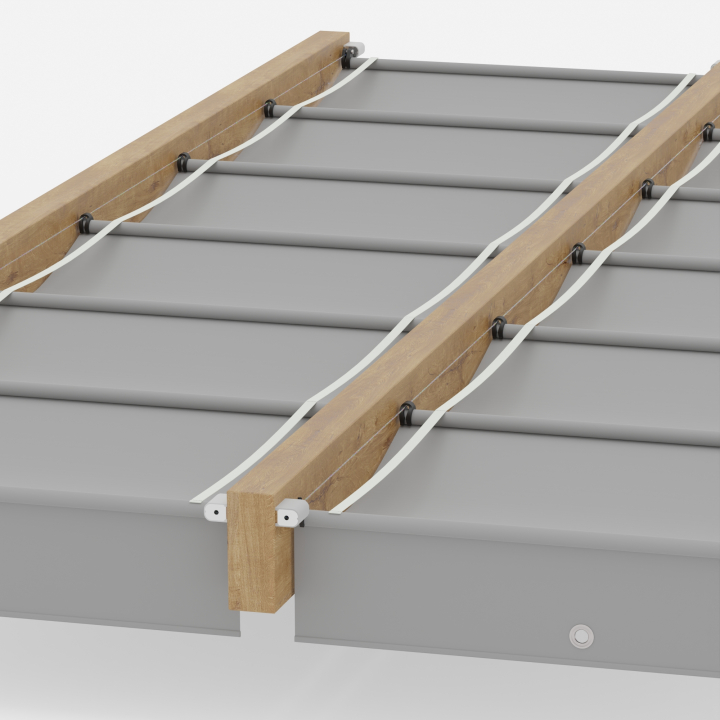
- On the pergola: fabric pergola sun protection hangs from the frame, not from the house wall. The cable tensioners sit on the rafters or directly on the metal profile. Screws still go into the frame.
- On the railing: a balcony cloth is tied to the railing. This is the only solution with no drilling at all.
- The pergola itself: it stands freely or is clamped between floor and ceiling. How it stands securely is set by its manufacturer. We do not make pergolas.
- Rented flat: get the landlord's written consent, even for constructions without drilling.
- Unsure whether it will hold: send us a photo. If the situation is unclear, we first make a single panel for testing.
- Weather: textile sun protection is not a storm or rain roof. In rain and storms, retract it.
Which solution suits your balcony
Whether you can manage without drilling depends on what is already on your balcony. What is a pergola explains exactly what a pergola is. Here we only deal with the question of what the shading hangs from.
A pergola is already there
Then its frame carries the shading. The cable tensioners are screwed to the rafters or the profile, and the house wall stays free. Which roofs are possible for a pergola is explained in What do you call a pergola with a roof.
Freestanding or clamped pergola
Pergolas for the balcony stand freely on the floor or are clamped with poles between floor and ceiling. How to secure them against wind is in the manufacturer's instructions. Only once the pergola stands securely is the sun protection added.
Only a railing
Without a pergola and without a ceiling, that leaves the railing. A cloth with eyelets is tied there and gives shade and privacy from the side. How that works is explained in the section No drilling at all.
Balcony with a ceiling above
Shading under the balcony ceiling is fixed in the ceiling or to the end face of the wall. That does not work without drilling. Then check whether a pergola or the railing is an option for you.
Pergola on the patio
For a patio pergola without drilling, the same applies as on the balcony: it stands freely and carries the sun protection itself. A freestanding one with a solid roof is often called a gazebo. The difference is explained in Pergola or gazebo.
Ideas for the roof
Whether fabric, plants or a combination: you will find ideas for shading from above in pergola roof ideas.
Fix the sun protection to the pergola frame

If a pergola stands on the balcony, its frame is the fixing point for the shading. With a rope tension awning, the fabric panels run on cables that are tensioned from front to back in the frame. The cables pull permanently on the frame. It must therefore be sturdy enough and itself stand securely. Whether the panels run between or under the rafters is explained in sun protection over or under the patio roof.
- Wooden frame: the stainless steel cable tensioner is fixed to the rafter with a wood mounting plate.
- Metal frame of steel or aluminium: the cable tensioner is screwed directly to the metal profile, and the mounting plate is not needed.
- Aluminium: the standard screws are wood screws. For aluminium profiles we supply stainless steel screws with a self-tapping tip on request, M5 or M6 depending on wall thickness.
- Frame without a front cross-connection: then the outer cable guides sit at the side on the supports, and the middle ones under the crossbeams.
- Scope of delivery: cable tensioners, sliders, polyester rope, stoppers, operating pole and a GERMES tool set are included. You need a drill and a screwdriver.
- Fitting: how to set the cables and hang the panel is shown in fitting a rope tension awning.
Cloth on the balcony railing

On the railing you manage without a single hole: a cloth is tied there and gives shade and privacy from the side, but does not replace a roof. We make the right cloth as a made-to-measure balcony cloth. How it holds on the railing and which options there are for a shade sail is explained in shade sail on a balcony without drilling. If the privacy screen is to hang at the side of a pergola, fixing a pergola curtain helps.
If it is unclear whether it will hold
If you use your own brackets or clamping constructions, you do so at your own risk and without a warranty from us. Send us a photo of the spot beforehand.
If we cannot judge from a distance whether the fixing will hold, we first make a single panel. You fit it at your own responsibility. If it holds, we make the remaining panels.
Four steps to a solution without drilling
Get consent
If you rent, get the landlord's written consent. That also applies to a pergola that is only clamped, and to a cloth on the railing.
Find load-bearing points
Decide what the shading hangs from: the frame of a pergola or the railing. Both must hold the tensile load permanently.
Check the material
Find out whether the frame is made of wood or metal. That decides how the cable tensioner is fixed. If in doubt, send us a photo.
Choose a solution
For shade from above in the pergola frame, the rope tension awning is suitable, and for angled leftover areas the rope tension shade sail. On the railing it is the balcony cloth. How fitting then works is explained with each solution.
Retract, retension, keep clean
Not a storm or rain roof
Textile sun protection is not a storm or rain roof and not weather protection. In rain, strong wind and storms, you retract the panels. Wet fabric becomes heavy and strains the cables and fixings. If you want rain protection on the pergola, you need a solid roof.
Park the fabric bundle under cover
The retracted fabric bundle belongs under a shelter. On an open pergola without a roof, that needs a sheltered spot, and it must not lie out in the weather. If the pergola stands completely open in the wind, a rope tension shade sail is lighter and less prone to wind.
Retensioning
If the panel sags, retension the cables using the thread of the tensioners. If the panel slides back by itself, a lightly tightened cable tie on the last pair of sliders helps.
Clean the pergola roof
If your pergola has a glass or plastic roof, read cleaning a patio roof to see how to keep it clean with a telescopic pole.
Order pergola shading made to measure
For shading in the pergola frame we make the made-to-measure rope tension awning: sliding fabric panels on tensioned cables, operated by hand, without a motor and without electricity. For areas that are not rectangular, there is the made-to-measure rope tension shade sail. We make both in Westoverledingen, Made in Germany. You will find more topics in the pergola guide.
Width and length
You measure the length of the rope tension awning including the cable tensioning device. Exactly where to measure is shown in How do I measure a rope tension awning?
Several panels instead of one
A single panel across the whole pergola is not technically possible. The area is divided into parallel panels of around 150 cm, which you move one by one.
Cable guides per panel
Under 145 cm panel width it needs 2 cable guides, from 145 cm 3, from 300 cm 4. From a length of about 6.5 m we recommend stainless steel wire rope.
Angled leftover areas
Rectangular bays get rope tension awnings, and a trapezoid leftover area gets a rope tension shade sail in the same fabric. That keeps the look uniform.
Four fabrics
The choice is Dralon, Polysun, Agora and Olefin. Dralon and Agora come from Spain. Agora carries a 5-year warranty on colour fastness, Polysun and Olefin a 2-year warranty on colour fastness.
Frequently Asked Questions
Sources
Last reviewed: 09.11.2026 · Reviewer: Germes-Team
Questions about shading your balcony?
Send us a photo of your pergola or railing and the dimensions. We will tell you which fixing suits and how the sun protection holds there.