





Sewing an awning
fabric, seam and tube pockets
Sewing an awning means, for the rope tension awning: a straight panel of fabric with a valance and pockets sewn across it, in which aluminium tubes sit. This page shows which awning fabric suits the job, where a seam belongs and where it does not, how to space the pockets and what to watch for with thread and needle. The values come from our production in Westoverledingen.

A panel for the rope tension awning is a straight cut of outdoor fabric. Fabric pockets are sewn across the panel, and in each one an aluminium tube with a 19 mm diameter sits hidden. The tubes glide on the ropes, and the fabric hangs between them. You can read how the rope tension awning works compared with other designs under what are awnings.
- Fabric: the panel width must fit the roll width. The length then runs along the roll, and the panel stays free of a seam across its width.
- Pockets: as standard, the tubes sit every 38 to 41 cm. There is always one tube more than there are sections.
- Width: tube and end caps together are 10 mm shorter than the clear width between the rafters. That leaves about 5 mm of clearance on each side.
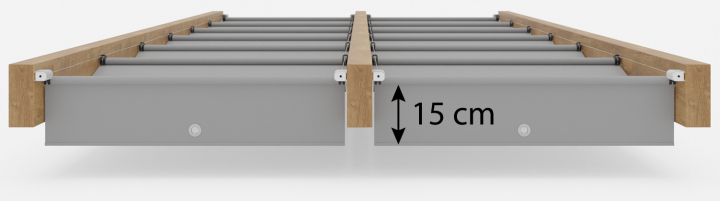
- Front: the valance is 15 cm high as standard, and the eyelet for the operating pole is punched in.
- Accuracy: we make awning panels with a tolerance of 0.5 cm in width and 2 cm in length.
Which fabric suits sewing
If you want to sew awning fabric, choose the fabric first by roll width. Four fabrics are available in our rope tension awning configurator. Which fibre suits your spot is compared in awning fabric: acrylic or polyester. Before cutting, it is worth looking at real fabric samples.
Dralon and Agora in 320 cm
Dralon comes in 160 and 320 cm width, Agora Liso in 137, 160 and 320 cm. Agora Liso in 320 cm is not available in all colours. With 320 cm, you get wide panels without a centre seam. Both fabrics come from Spain.
Polysun and olefin narrower
Polysun is 160 cm wide, olefin 150 cm. That is enough for panels up to this width, because the length runs along the roll.
Olefin for large areas
Olefin is denser than the other three fabrics. We do not recommend it for larger awning areas, and fitting the gliders on the aluminium tube is more laborious.
What the data sheets say about the seam
Polysun: seam strength 489 N in the warp and 451 N in the weft according to ISO 13935-2. Agora Liso: seam slippage 5.6 mm in the warp and 3.0 mm in the weft according to ISO 13936-2. Olefin: seam slippage resistance 4.0 mm in warp and weft according to ISO 13936-2. The first standard measures the force at which a seam tears, the second how far a seam opens under tension.
Where a seam belongs and where it does not
Before you sew a seam on the awning, decide where seams sit at all. We sew every panel up to 320 cm width from one piece, with no seam across the width. Such a seam would be the most likely weak point in wind. If the area is wider, several panels go side by side. Every seam is also a place where water can get through in lasting rain. You can read whether re-proofing afterwards helps under waterproofing an awning. If you want to sew a seam in awning fabric that has already hung outside, wash and dry the panel first, see cleaning an awning. Remove mildew spots before sewing, as described under removing mildew spots.
- Mainly the tube pockets and the valance at the front are sewn. Across the width, the panel stays free of a seam.
- Thread: the fabric stands in the sun for years. The thread must withstand that just as well, otherwise the seam gives way before the fabric. Use outdoor thread, not thread for clothing.
- Needle and stitch: we do not give a fixed needle or thread size, because it depends on the fabric, the number of layers and the machine. First sew a test on an offcut with the same number of layers as at the pocket.
Calculating and sewing tube pockets
Take the clear width
Measure the width between the rafters or profiles, that is, the free distance between the two mounting points. This is the reference dimension for fabric and tube.
Set the finished length
The finished length is the tensioned span between the wire rope tensioners. For the taut look it stays as it is, and for the cloud look about 5 to 7 percent is added.
Divide into sections
Divide the finished length into equal sections of 38 to 41 cm. The number of tubes is the number of sections plus one. Example: a finished length of 320 cm gives 8 sections of 40 cm and 9 tubes.
Sew the pockets
Sew the pockets across the whole width, at the same spacing as the sections. The aluminium tube with a 19 mm diameter must slide through without jamming.
Valance and eyelet
At the front, the panel ends in the valance, 15 cm high as standard. The eyelet that the operating pole engages sits in it. On request we also make the valance lower, for example 10 cm.
Slide in the tubes
Cut the aluminium tubes to the clear width minus 15 mm and fit a plastic cap on both ends. That leaves about 5 mm of play on each side to the rafter.
Gliders, rope guides and cloud strap
The finished panel hangs from the ropes with gliders. How the ropes are set and tensioned, and in what order the panel is added, is shown in the rope tension awning assembly. For sewing, all that counts is how many ropes guide the panel and whether a strap is added.
Rope guides by panel width
Below 145 cm panel width, 2 ropes guide the panel, from 145 cm 3, from 300 cm 4. For each rope guide, a glider sits on every tube. Gliders and rope guides can be moved along the tubes, they do not have to sit right at the outer ends.
Cloud strap on a slope
With the cloud look, the tubes slide downwards on a slope. The cloud strap keeps them apart: two straps per panel, at the two sides, firmly sewn to each fabric pocket. The strap is as long as the tensioned span with no allowance. From about 7 to 8 percent slope, the cloud look is only available with a strap, otherwise the taut look.
Pocket spacing and fabric stack
Between two tubes, the fabric sags in the retracted state about half as deep as the section is long, so about 20 cm at 40 cm. Sections spaced more closely, about 33 to 35 cm, sag less, but need more pockets.
Wide panels
Standard panels are around 150 cm. A panel 3 m wide is hard to extend and retract evenly by hand. So rather sew wide areas as several narrow panels.
Not a storm or rain roof
A rope tension awning is sun protection, not a storm or rain roof. In rain, strong wind and storms, you push the panel together and park the fabric stack under the roof.
If you do not want to sew everything yourself
The components for a panel you sew yourself are available individually, for example the aluminium tube with a 19 mm diameter. You will find the whole building plan with ropes and stainless steel wire rope tensioners under making a rope tension awning yourself.
Ready-made panel to measure
We sew every panel by hand to your measurements in Westoverledingen, with pockets, tubes, valance and complete mounting accessories: made-to-measure rope tension awning. It is operated by hand with the operating pole, without a motor and without electricity.
Folding awning on rails
On the folding awning, the panel does not hang from tubes, but from hook-and-loop profiles with sewn-on velour tapes at a spacing of about 40 cm: made-to-measure folding awning.
New fabric for the old awning
If an existing awning is to get a new fabric, read re-covering an awning.
Your own fabric
If you have your own awning fabric, ask us. In individual cases we also work with fabric you bring in, after our production has checked a sample.
No sewing at all
If you want to neither sew nor mount an awning, you will find ideas under alternatives to an awning.
Frequently Asked Questions
Sources
- Awning guide
- Made-to-measure rope tension awning
- Rope tension awning assembly
- Awning fabric: acrylic or polyester
Last reviewed: 23.10.2026 · Reviewer: Germes-Team
Would you rather have it sewn?
Send us the clear width between your rafters and the tensioned span. We will tell you how many panels and which fabric suit, and on request we send fabric samples.