





Awning fabric: acrylic or polyester?
four rope tension awning fabrics compared
Whether an awning fabric made of acrylic or polyester suits you better depends less on the fibre than on how it is dyed. Solution-dyed acrylic and solution-dyed polyester reach the same lightfastness, but acrylic ages more slowly under UV. Here we compare the four fabrics of our rope tension awning with measured values, guarantee and care, and tell you when light or dark shades work.
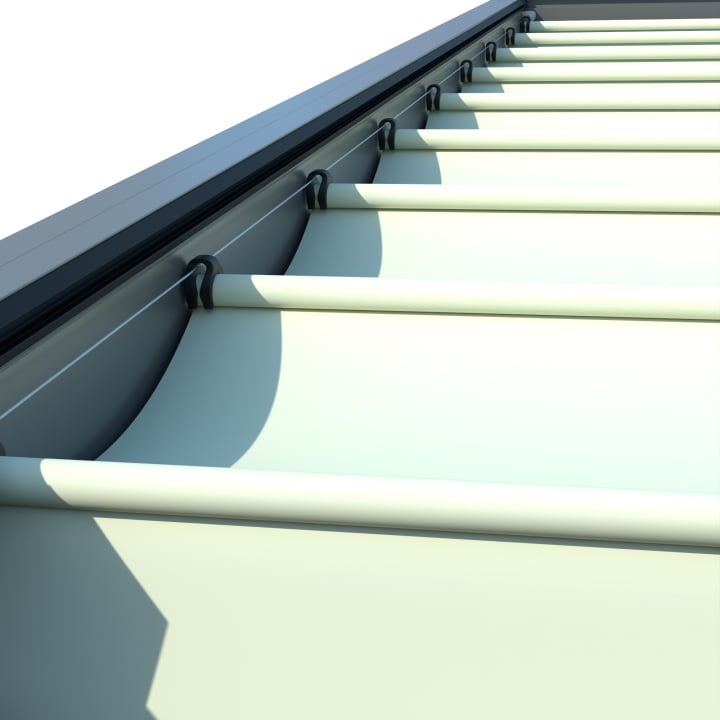
Acrylic or polyester for the awning: with the same lightfastness, solution-dyed acrylic lasts longer, and polyester is the more budget-conscious choice. More important than the fibre is whether the fabric is solution-dyed. The four fabrics in the configurator of our rope tension awning:
- Agora, solution-dyed acrylic: lightfastness 7-8 out of 8, 5-year guarantee on colour retention (colourfastness), slightly more expensive.
- Polysun, solution-dyed polyester: lightfastness 7-8, 2-year guarantee on colour retention. Polyester ages faster under UV than acrylic.
- Dralon, conventionally dyed acrylic: lightfastness 4-6 out of 8, no colour guarantee. Checked and patterned outdoor fabrics are only available from us in Dralon.
- Olefin, polypropylene: lightfastness above 7, 2-year guarantee on colour retention. Dense fabric, so better suited to narrow panels.
- Care: Agora tolerates diluted bleach 1:20, Polysun only hand washing without bleach.
The four awning fabrics compared
The values come from the fabrics' data sheets. Lightfastness is measured according to ISO 105-B02 on a scale of 1 to 8, and abrasion resistance in the Martindale test in cycles. All four fabrics have a water-repellent finish.
| Fabric | Fibre and dyeing | Lightfastness | Colour guarantee | Weight | Abrasion resistance | Price |
|---|---|---|---|---|---|---|
| Agora Liso | Acrylic, solution-dyed | 7-8 out of 8 | 5 years | 260 g/m² | 20,000 cycles | slightly more expensive |
| Polysun | Polyester, solution-dyed | 7-8 | 2 years | 260 g/m² | 60,000 cycles | budget-conscious |
| Dralon | Acrylic, conventionally dyed | 4-6 out of 8 | none | 220 g/m² | no data | entry level |
| Olefin | Polypropylene | above 7 | 2 years | around 260 g/m² | 16,000 cycles | relatively inexpensive |
The difference between acrylic and polyester in awning fabric
Acrylic and polyester are both synthetic fibres. For the awning, two things matter most: how the colour gets into the fibre and how the fibre itself copes with UV radiation.
The dyeing matters more than the fibre
With solution-dyed fabrics, the colour is added to the liquid polymer solution, and the fibre is dyed right through to the core. Agora and Polysun are dyed this way and reach 7-8. Dralon is conventionally dyed and sits at 4-6 out of 8. More under What does solution-dyed mean?
Polyester ages faster under UV
Polyester is not as resistant to UV radiation as acrylic and breaks down faster at material level. With almost the same lightfastness, Polysun therefore does not last as long as Agora. Agora has a 5-year guarantee on colour retention, Polysun 2 years.
Polyester is more abrasion-resistant
In the Martindale test, Polysun reaches 60,000 cycles, Agora 20,000 and Olefin 16,000. Polysun is therefore mechanically more durable, but that does not change its lifespan under UV.
UV protection for you underneath
The UPF according to AS/NZS 4399 measures how much UV radiation passes through the fabric. Agora reaches UPF 50+ and blocks more than 98 % of UV radiation, Dralon UPF 50. We have no UPF value for Polysun and Olefin.
Acrylic tolerates more when it comes to care
You clean Agora with lukewarm water and neutral soap, and diluted bleach 1:20 is allowed. Dralon, Polysun and Olefin do not tolerate bleach, and Polysun only hand washing up to 30 degrees. How to go about it is explained under Cleaning an awning, and for mildew under Removing mildew spots.
Acrylic feels soft
Dralon and Agora are both 100 % acrylic and have a similarly soft, cotton-like feel. Agora and Dralon come from Spain.
When acrylic is the better choice
As a rule of thumb, lightfastness is what counts: for fabrics that are only outdoors from spring to autumn, 5-6 out of 8 is enough. If the fabric hangs in the sun all year round, 7-8 out of 8 is recommended.
Full sun, many years
Agora: the colour goes right into the fibre core, lightfastness 7-8 out of 8. Agora comes with a 5-year guarantee on colour retention (colourfastness). Agora costs a little more, and the configurator shows the price. More under Agora Liso.
Glass roof over the patio
Under a glass roof the UV load is higher, and there is no wind to cool the fabric. If you want a dark shade there with the best possible colour retention, we recommend Agora. The more budget-conscious solution-dyed alternative is Polysun.
Check or pattern
Checked and patterned outdoor fabrics are only available from us in Dralon. Dralon sits at 4-6 out of 8: light and medium shades rather at 6, strong and dark ones rather at 4. More under Dralon.
Used seasonally, small budget
If you bring the fabric indoors over the winter, Dralon is well suited as a proven acrylic fabric. With constant year-round use in full sun, sensitive colours can fade after a few years.
When polyester is the better choice
Polysun is solution-dyed polyester. It matches Agora for lightfastness, costs less and in return does not last quite as long.
Good lightfastness, smaller budget
Polysun reaches lightfastness 7-8 and is clearly above Dralon for colour retention. There is a 2-year guarantee on colour retention. More under Polysun.
Dark shades in full sun
Anthracite and other dark shades show fading first. If you want them in full sun and the price matters, choose Polysun instead of Dralon.
The limit of polyester
Under UV, polyester breaks down faster than acrylic. If you plan the awning for many years in full sun, Agora is the longer-lasting choice. You wash Polysun by hand only and without bleach.
And Olefin?
Olefin is the third fibre in the configurator: polypropylene, lightfastness above 7, the fibre absorbs no water, 2-year guarantee on colour retention. The fabric is denser, we do not recommend it for larger awning areas, and the sliders are harder to fit on the aluminium tube. With narrow panels this is not a problem. More under Olefin.
Light or dark awning: which is better?
Both have their place. The difference shows less in the first summer than in the years after: a dark shade needs a fabric that keeps its colour even in full sun.
Light shades are more forgiving
Within a fabric collection, light shades usually reach higher lightfastness values. If the colour does fade a little after years, it is much less noticeable on beige or sand.
Dark shades show uneven sun
Anthracite, dark blue or black show fading with more contrast. On an awning, the sun does not hit everywhere equally: the shadow of the valance on the panel below, the edge of the roof shade, the inside of the folds when pushed together. With conventionally dyed fabric, a visible line can appear after one or two seasons.
Dark works with the right fabric
With solution-dyed fabrics, the colour sits in the fibre core. For dark shades in full sun we therefore recommend Agora with a 5-year guarantee or Polysun with a 2-year guarantee, not Dralon.
Colour is not UV protection
Lightfastness tells you how long the colour lasts. The UPF tells you how much UV radiation gets through. We have not measured how much cooler it is under a light fabric, so we make no statement on that.
Four plain shades from the Agora collection as an example. The safest way to decide is with a fabric sample in your hand, outdoors in daylight.

Light, fading is hardly noticeable.

Light natural shade, calm in appearance.

Dark, needs high lightfastness.

Very dark, shadow edges show up more easily.
What no awning fabric can do
Whether acrylic, polyester or polypropylene: the rope tension awning is pure sun protection. In rain, storms and bad weather you retract it and park the fabric bundle under the roof.
All four fabrics are water-repellent: normal rain beads off, but with continuous or heavy rain water gets through. What that means for the awning in rain is explained under Leaving an awning out in the rain?
If your awning is to get a different fabric, the same values apply as when buying. How to re-cover it is explained under Re-covering an awning.
Which types of awning exist and where their limits lie is explained under What are awnings?
Frequently Asked Questions
Sources
Last reviewed: 23.10.2026 · Reviewer: Germes-Team
Not sure which fabric suits your awning?
Send us a photo of your patio and tell us which colour you have in mind. We will tell you which fabric suits and, if you wish, send fabric samples so you can see the colour in daylight.