





Fixing a Curtain to a Pergola
with wire rope or track
You fix a curtain to a pergola either on a tensioned wire rope or on an aluminium track. Which hanging system suits depends mainly on what your pergola offers: posts, cross beams, house wall or rafters. Here you can read what the rope and track hold on to and what applies to sloping beams.
A curtain on a pergola hangs at the side, between two posts or between a post and the house wall. There are two hanging systems for this, and both are proven.
- Wire rope: eye bolts in the post and house wall, with a stainless steel rope and turnbuckle between them. The curtain hangs from carabiners, typically every 10 cm. Over a span of 200 cm, an eye bolt goes in the middle, so wide bays get a split curtain.
- Track: an aluminium track on wall or ceiling brackets, with a bracket about every 80 cm. The curtain runs on runners, typically every 20 cm. A lock at the entry opening holds the first runner in place.
- Sloping beam: only the track works here. On a rope, the curtain slides to the lower side.
- Height: only measure once the eye bolts or track are in place. With wire rope, measurements estimated in advance are often off by 5 to 15 cm. The curtain ends just above the floor and never rests on it.
What the Curtain Hangs From on a Pergola
First look at which fixed points your pergola offers on the open side. What makes a pergola and which designs exist is explained under What is a pergola?
On the post
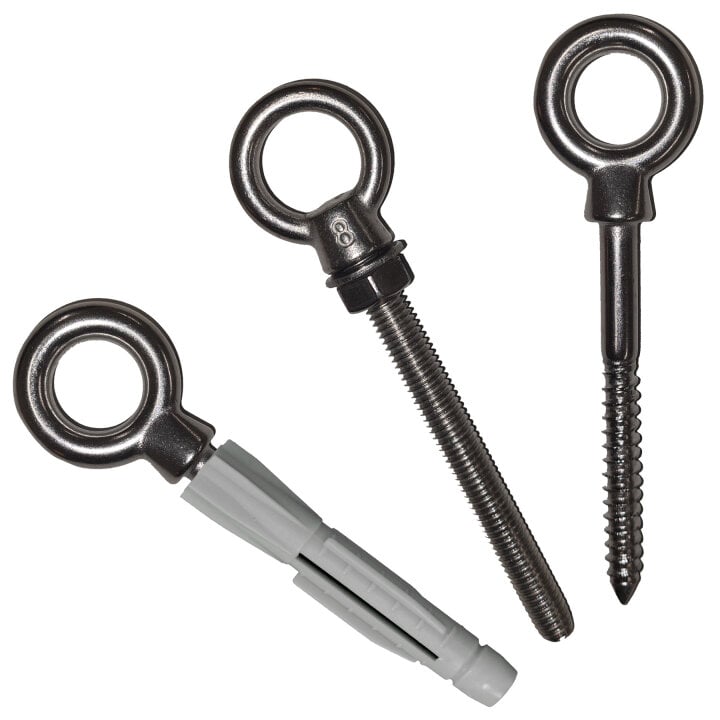
The eye bolt for the wire rope sits in the corner or support post. It is drilled through the material of the post. The post is thus the fixed end point on the garden side.
On the cross beam
If a beam runs from post to post over the opening, the track sits underneath. The brackets are screwed into the beam from below, about one every 80 cm.
On the house wall
On the house wall, the eye bolt sits in the masonry with a wall plug. On an insulated facade, the fixing has to reach through the insulation into the load-bearing masonry.
Under the patio roof
Under a patio cover or a conservatory roof, the track hangs under the rafter or on the front beam. Fixing is to rafters and beams, not to the glass or plastic panels. Whether sun protection from above belongs over or under the roof is explained in Sun protection over or under the patio roof.
Thin aluminium profiles
Not every structure can carry the tension of a tensioned rope permanently, and thin aluminium profiles often have little reserve. We cannot judge from a distance whether a material holds the screws securely. If in doubt, send us a photo.
Rented flat and no drilling
Rope and track are screwed or plugged in. If you rent, clarify this with your landlord beforehand. Solutions without a drill hole are described in Pergola on a balcony without drilling.
Wire Rope or Track for Your Pergola
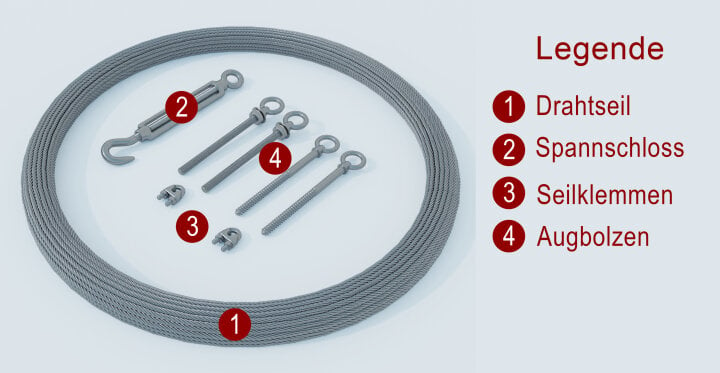
The look usually decides, followed by the construction of the pergola. Both systems are available as separate items in your length: the wire rope system for outdoor curtains and the track system for outdoor curtains.
- Look: the wire rope looks slim and understated. The track looks more formal and technical, and some find it too bulky.
- Span: on a rope, an eye bolt sits every 200 cm at the latest. A one-piece curtain across a wide bay would have this bolt in the middle of the panel. On a track, one curtain hangs in one piece per bay.
- Wind: on a rope, stoppers hold the curtain in place. In very windy spots, eyelets and carabiners can slide over them. On a track, the closed lock holds the first runner.
- Slope: on a sloping beam, only the track comes into question.
- Top hem: on a rope, the curtain has a gathering tape with carabiners every 10 cm, and on a track eyelets every 20 cm. A curtain with eyelets can also hang on a rope.
Four Steps to the Right Fixing
Check the structure
Establish what the curtain hangs from: post, cross beam, house wall or rafters. The material has to hold the screws permanently.
Choose the hanging system
Wire rope or track, depending on look, span and wind. On a sloping beam, you use the track.
Fix it to the post and beam
For the rope, fit one eye bolt in the post on the garden side and one in the house wall, and over a span of 200 cm another in the middle. Screw the track to the cross beam or rafters from below, with a bracket about every 80 cm.
Tension the rope and hang the curtain
Tension the rope with the turnbuckle and hang the curtain with the carabiners. On the track, the runners slide in through the entry opening, and then you close the lock. Only measure the height once the rope or track is in place.
Curtain on a Sloping Pergola
Many pergolas and patio roofs slope towards the garden side. A few rules of their own then apply to the curtain.
Track only
On a sloping beam, wire rope is ruled out. Gravity pulls the curtain on the rope to the lower side, and stoppers do not hold it reliably in wind. The track keeps the runners in place even on a slope.
Secure the high side
If there is no post on the higher side, push the first runner in front of or behind the entry opening and close the lock. That way the curtain does not slide down.
Sloping at the top, straight at the bottom
The top hem can follow the slope, while the bottom stays straight because the lead tape and corner eyelets sit there. This makes the curtain trapezoid-shaped. Matching curtains are available as an outdoor curtain for a sloping roof.
Taut instead of in waves
For a curtain on a slope, we advise against wave fullness. On a slope, the bundle of fabric slides forward and gathers. Made taut, it hangs more calmly.
Wind, Rain and Winter
An outdoor curtain gives privacy, sun and wind protection for the patio under the pergola. Textile sun protection is not a storm or rain roof. If you want protection from rain at the pergola, you need a solid roof.
Weight it at the bottom
Lead tape in the bottom hem and eyelets that you tie down at the bottom keep the curtain calm. How heavy the tape is and what you tie the eyelets to is explained under Weighting an outdoor curtain.
Windy spot
If your pergola is exposed to a lot of wind, the track with a lock is the more reliable hanging system. The runner cannot pass the closed opening. What else applies in wind and in winter is shown in the Ideas for wind protection on the patio.
Water-repellent, not waterproof
Agora fabrics are water-repellent, and rain beads off. They are not waterproof. When not in use, push the curtain to the house wall and tie it up, so the hem stays out of the splash water.
Take it down in winter
Take the curtain down in winter and store it dry. The bottom fixing cannot take permanent loads of ice and snow. How to clean the fabric is explained in the Care instructions for outdoor curtains.
Re-tension the rope
Tighten the turnbuckle after winter and when the temperature changes. A sagging rope lets the hem drag on the floor.
Outdoor Curtain and Sun Protection for Your Pergola
We sew the curtain to your measurements in Westoverledingen, Made in Germany. You put together the fabric, hems and hanging system in the made-to-measure outdoor curtain. How to fit the rope or track step by step and hang the curtain is shown in the Installation instructions for outdoor curtains.
Two fabrics
Agora Air is semi-transparent and lets light through, while Agora Liso is opaque. Both fabrics come from Spain and carry a 5-year guarantee on colour fastness. Free fabric swatches show how they look in the original.
Shade from above
The curtain protects at the side. Pergola sun protection from above is provided by the rope tension awning between the rafters or the rope tension shade sail.
Roof and ideas
Which roof types exist is explained in What do you call a pergola with a roof? Inspiration for the design is shown in the 10 pergola roof ideas.
Send a photo
Not sure which hanging system suits your pergola? Send us a photo and the measurements via the Service Centre.
Frequently Asked Questions
Sources
- Pergola Guide
- Made-to-Measure Outdoor Curtain
- Wire Rope System for Outdoor Curtains
- Track System for Outdoor Curtains
Last reviewed: 09.11.2026 · Reviewer: Germes-Team
Questions about Fixing to Your Pergola?
Send us a photo of the open side and the measurements. We will tell you whether wire rope or track suits and what the curtain hangs from.