





Shade sail test
the checklist for fabric, hold, design and shape
We will not name a test winner here. We show you which values you can compare yourself: lightfastness, UV protection, water column and colour guarantee for the fabric, plus corners, anchor points and slope for the hold. The figures come from the data sheets of our fabrics and from our production.
You check a shade sail in two places: the fabric and the hold. Both can be compared with figures that appear on any good data sheet.
- Lightfastness according to ISO 105-B02: for a sail that hangs outside the whole season, 7 to 8 out of 8 is recommended.
- UV protection according to AS/NZS 4399: UPF 50+ lets through less than 2 percent of UV radiation, measured on new, dry fabric.
- Water: normal rain beads off water-repellent Agora with a 180 mm water column, but with continuous or heavy rain water gets through. The waterproof cover version with over 1,500 mm water column also keeps out heavy rain.
- Colour guarantee: Agora 5 years, Olefin 2 years guarantee on colour retention (colourfastness). Always ask about the duration.
- Hold: a stainless steel ring in every corner, load-bearing anchor points and 25 to 30 cm of slope per metre.
- Not a storm or rain roof: you retract rope tension systems in rain, strong wind and storms, and you take a fixed-tension sail down in storms.
How to recognise good shade sails
There is no single best shade sail for every spot. Whether a sail suits you depends on your spot and your weather. But you can check these six points on any offer. The measured values of our fabrics side by side are listed under Shade sail: which material.
Lightfastness 7 to 8 out of 8
The grade according to ISO 105-B02 shows how well the colour withstands light. For year-round use outdoors, 7 to 8 out of 8 is recommended, and for the season from April to September 5 to 6 is enough. Solution-dyed fabrics typically reach higher values, because the colour is in the fibre and not on top.
UPF 50+ with a standard
UPF 50+ is the highest class according to AS/NZS 4399. The standard tests the fabric new, dry and unstretched. Make sure the standard is named alongside a UPF value.
Water-repellent or waterproof
Water-repellent is not waterproof. Normal rain beads off Agora with a 180 mm water column, but with continuous or heavy rain water gets through. It only stays dry under a coated fabric such as the cover version. More on this under Shade sail waterproof and winter-proof.
How long does the colour guarantee last?
It differs from fabric to fabric: Agora has 5 years, Olefin 2 years guarantee on colour retention (colourfastness). With every offer, ask how long the guarantee lasts.
Woven fabric instead of mesh
Knitted HDPE mesh made of polyethylene at 160 to 220 g/m² is often sold as a shade sail. It is air-permeable but does not keep out rain. Our sails are made of densely woven outdoor fabrics at 240 to 260 g/m².
Light and dark colours
How the shade affects durability is explained under Shade sail: which colour.
The hold counts too
A good fabric is of little use if a corner or fixing gives way. So also check how the sail is held. The detailed guide is under Attaching a shade sail.
Stainless steel ring instead of a punched eyelet
In the corner of our sails sits a stainless steel fixing ring, where you hook in the carabiner and turnbuckle.
Load-bearing points
Masonry, concrete and a post in a pad foundation hold the pull, but a gutter and a trellis do not. Where you are not allowed to drill, Shade sail on the balcony without drilling helps.
30 to 50 cm per corner
Between the sail corner and the anchor point sit the carabiner and turnbuckle. The distance between the points is therefore larger than the sail itself.
Slope for the rain
One corner sits 25 to 30 cm lower per metre, measured across the diagonal. How to get the sail taut is shown in How to tension a shade sail.
Rope tension system on the facade
With the rope tension shade sail, stainless steel turnbuckles with a facade plate count as a particularly stable way of mounting, above all without a roofed structure. The standard is a polyester rope. We supply stainless steel wire rope only by arrangement, for example from a rope length of about 6.5 m.
Sail to your drawing
If we make a permanently installed sail to your drawing, eyelets with a 2 cm inner diameter at a spacing of about 30 cm are possible, plus closed loops of about 40 cm.
Two shade sail designs and the rope tension awning
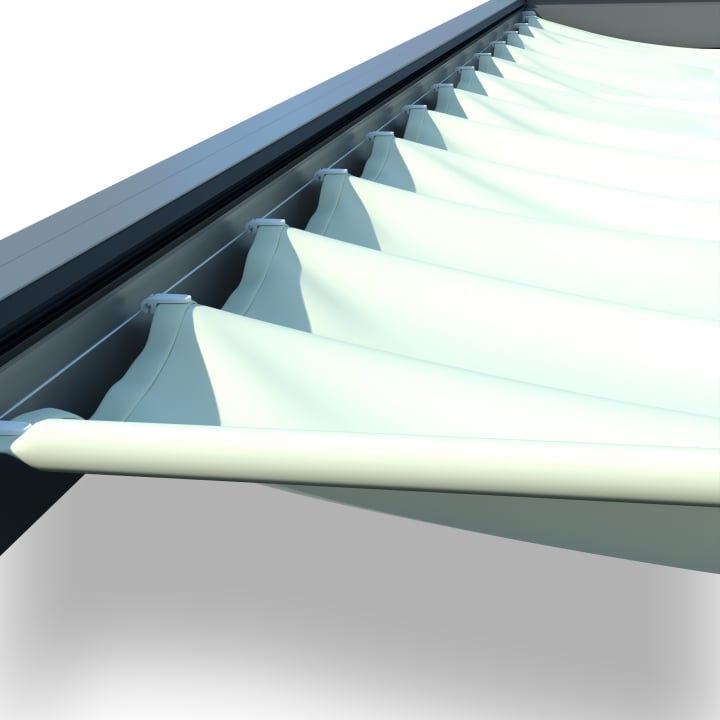
Before comparing, check which design you need. A shade sail comes fixed-tension or as a rope tension shade sail on two support ropes. The rope tension awning also runs on ropes, but consists of individual panels. You will find fixed-tension sails under Shade sail made to measure, and the movable one under Rope tension shade sail made to measure.
| Design | Construction | Operation | Rain and storms | Limits from production |
|---|---|---|---|---|
| Fixed-tension shade sail | Fabric with three or four corners, stainless steel ring at each corner, as a triangle, square, rectangle, trapezoid or to your drawing | stays at its points through the season | weather-resistant but not storm-proof; take down in storms and before winter | also on steeply sloping areas and in exposed locations |
| Rope tension shade sail | continuous sail without tube divisions on two support ropes, between or under the rafters or without a roofed structure on facade plates | slide to the side, with a parking position | pure sun protection; retract in rain, strong wind and storms | lighter and less exposed to wind, so the choice without a roofed structure; when retracted the sail sits under cover, otherwise take it down beforehand; it does not replace a roof, without a roof at your own risk |
| Rope tension awning | panels with sewn-in aluminium tubes in even sections under a pergola or patio roof | retract and extend panels individually | pure sun protection; retract in rain, strong wind and storms | under 145 cm panel width 2 rope guides, from 145 cm 3, from 300 cm 4 |
What no shade sail can do
The rope tension awning and the rope tension shade sail are pure sun protection. In rain, strong wind and storms you retract them and park the fabric bundle under cover.
You also take a fixed-tension sail down when a storm is forecast and before winter, let it dry and store it dry. What applies in wind is explained under Shade sails in wind, and the care before storing under Cleaning a shade sail.
If a sail is tensioned too flat, rain collects in the fabric. With a water-repellent sail, standing water gets through in time. With 25 to 30 cm of slope per metre, normal rain runs off.
The waterproof cover version lets no air through. Without enough slope, water collects in the fabric, and the heat builds up a little more underneath than under a water-repellent sail.
A triangular shade sail tested against a square and a rectangle
How big your sail gets follows from your anchor points. You compare the shape by the area it shades. All 23 fixed sizes from 2 x 2 m to 6 x 6 m are listed under Shade sail by size.
First the points, then the shape
Three points make a triangle, four make a square, a rectangle or a trapezoid. If the points are at an angle to each other, the sail is made to measure.
Area per shape
Put a triangle and a square with the same edge length side by side: the 3 x 3 x 3 m triangle has 3.9 m², the 3 x 3 m square 9 m². For about 20 m² a 4 x 5 m rectangle is enough, and with three points you need the 7 x 7 x 7 m triangle with 21.2 m².
Shade falls at an angle
The sun is never vertical. To the area that should be in shade, add half a metre on every side.
Frequently Asked Questions
Sources
Last reviewed: 23.10.2026 · Reviewer: Germes-Team
Do you want to compare two sails?
Send us the distances between your anchor points and tell us whether it should also stay dry underneath in rain. We will give you the version and size and sew the sail in Westoverledingen.