





Shade sail: which material suits?
Acrylic, Olefin and polyester compared
Which fabric suits a shade sail is decided by three questions: should it stay dry underneath in rain, how long should the colour last and which type of sail do you have in mind? There is no single material for every case. Here you will find the measured values of the fabrics we process in Westoverledingen, and the dividing line to the cheap HDPE mesh.
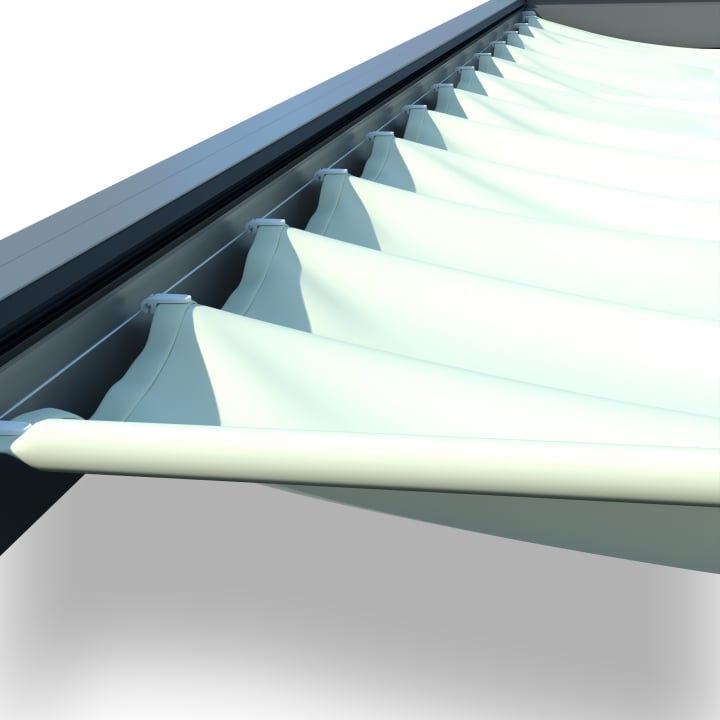
Tightly woven outdoor fabrics suit sails. Which material suits a shade sail in your spot depends on rain and on colour. The four fabrics of our shade sails and rope tension systems in one sentence each:
- Agora, solution-dyed acrylic: lightfastness 7-8 out of 8, UV protection UPF 50+, water-repellent, 5 years guarantee on colour stability (colour fastness).
- Olefin, polypropylene: lightfastness over 7, the fibre absorbs no water, 2 years guarantee on colour stability. Standard for sails made to your drawing.
- Polyester: as Cover with a PU coating it is waterproof with over 1,500 mm water column, as Polysun it is water-repellent. Polyester ages faster than acrylic under UV.
- Dralon, acrylic: lightfastness 4-6 out of 8, no colour guarantee, but also available patterned and 320 cm wide. For sails we sew Agora in plain colours only.
- HDPE mesh is not a woven fabric but knitted: breathable and cheap, but it does not keep out rain.
The fabrics compared
The values come from the fabrics' data sheets. Lightfastness is measured to ISO 105-B02 on a scale from 1 to 8, and the water column shows at what pressure water passes through the fabric.
| Fabric | Fibre | Lightfastness | Water | Weight and width | Colour guarantee |
|---|---|---|---|---|---|
| Agora Liso | 100 % solution-dyed acrylic | 7-8 out of 8 | water-repellent, water column 180 mm to UNE EN ISO 20811 | 260 g/m², 137, 160 or 320 cm | 5 years, manufacturer |
| Olefin | 100 % polypropylene | over 7 | water-repellent, 0 % moisture absorption | around 260 g/m², 150 cm | 2 years, Germes |
| Polysun | 100 % solution-dyed polyester | 7-8 | water-repellent, spray test 4 out of 5 to ISO 4920 | 260 g/m², 160 cm | 2 years, Germes |
| Cover | Polyester fabric, PU-coated | 7-8 out of 8 | waterproof, water column over 1,500 mm | 240 g/m² | not stated |
| Dralon (Acrisol) | 100 % acrylic | 4-6 out of 8 | water-repellent | 220 g/m², 160 or 320 cm | none |
Which fabric suits which spot
These six situations cover almost every enquiry we receive about fabric choice. Which colour goes with it is explained under shade sail: which colour.
Full sun, many years
Agora: the colour goes right to the core of the fibre, lightfastness 7-8 out of 8. UPF 50+ to AS/NZS 4399 means the fabric blocks more than 98 % of UV radiation. Agora comes with a 5 years guarantee on colour stability (colour fastness). More under Agora Liso.
Pool, sea, exposed position
Olefin: the polypropylene fibre absorbs no water and dries quickly. Chlorinated water and sea water each score 5 out of 5. For sails made to your drawing, Olefin is our standard. More under Olefin.
It should stay dry underneath
Then you need Cover, a PU-coated polyester fabric with over 1,500 mm water column. It lets no air through and needs a consistent slope. What else a waterproof sail demands is explained under waterproof and winter-proof shade sails.
Budget-conscious with the rope tension awning
Polysun is solution-dyed polyester with lightfastness 7-8 and a 2 years guarantee on colour stability. With almost the same lightfastness it does not last as long as acrylic, because polyester ages faster under UV.
Pattern instead of plain
For sails we sew Agora in plain colours only. Checked outdoor fabrics are available from us only in Dralon. Dralon reaches 4-6 out of 8 for lightfastness, light shades nearer 6, strong and dark ones nearer 4.
Large area without a centre seam
Agora and Dralon are also available 320 cm wide. Large sails and panels can then be made without a seam in the middle. Olefin is 150 cm wide.
Shade sail made of polyester or HDPE?
Many cheap shade sails on the market are made of HDPE. That is not a woven fabric like polyester or acrylic but a knitted shade mesh. We do not sew sails from HDPE. The differences in four points:
What HDPE is
A knitted mesh of polyethylene at 160 to 220 g/m². It is cheap, and lets air and wind through. This permeability is intended.
Rain goes through
HDPE lets water through. If you want to sit under the sail even during a shower, you need a tightly woven, water-repellent or coated fabric.
The colour does not last for years
With HDPE mesh the colour does not last for years. Woven outdoor fabrics are tested to ISO 105-B02: Agora and Cover reach 7-8 out of 8, Olefin over 7.
Polyester is not the same as polyester
Polyester comes waterproof-coated as in the Cover sail or water-repellent as in Polysun and the folding shade sail. Both are tightly woven. Compared with acrylic, polyester ages faster under UV.
Which fabric is in which shade sail
Not every fabric suits every type. A fixed tensioned sail hangs from its corners, rope tension systems run on ropes. Which fabrics are available where:
Fixed tensioned shade sail
Three versions: Agora and Olefin water-repellent, Cover waterproof. Agora comes in 10 colours, Olefin in 14, Cover in 5. The Cover version is priced above the two water-repellent ones. All shapes and sizes under made-to-measure shade sails.
Sail made to your drawing
For special shapes, Olefin is the standard, lightfast and water-repellent. We check other fabrics on request. RAL colours are not possible, only similar shades from the collection.
Rope tension awning
Four fabrics are in the configurator: Dralon, Olefin, Polysun and Agora, with Agora costing a little more. Olefin is denser, and we do not recommend it for larger areas. To the rope tension awning configurator.
Rope tension shade sail
The sliding sail on two support ropes is available in Dralon and Olefin: made-to-measure rope tension shade sail.
Folding shade sail
The folding shade sail is made of 100 % polyester and has a panel width of 150 cm at most.
What no fabric can do
Rope tension awning and rope tension shade sail are pure sun protection, whatever the fabric. In rain, strong wind and storms you retract them.
A fixed tensioned shade sail is weather-resistant but not storm-proof. When a storm is forecast and before winter, take it down. How to clean it afterwards is explained under cleaning a shade sail.
Normal rain beads off water-repellent Agora, but in prolonged or heavy rain water gets through. Tension the sail with a slope of 25 to 30 cm per metre, otherwise water stays standing in the cloth. How to set the slope is explained under tensioning a shade sail.
Agora is also available for cushions with a waterproof lamination. We do not use it in shade sails and awnings: the lamination is not UV-resistant and suffers from the constant movement of the fabric.
The corners and fixing points carry the tensile force on the sail. Which points can do that is explained under fixing a shade sail, and for a rented balcony under shade sail on a balcony without drilling.
Which fabric for sewing it yourself
If you sew your own sail, choose the fabric by the same values as for the finished sail.
Fabric by the metre
Our outdoor fabrics are also available as fabric by the metre. Look at the same values as for the finished sail: lightfastness, water behaviour and width. Hems, eyelets and allowances are explained in the guide sewing a shade sail.
A wide panel saves the centre seam
Agora Liso and Dralon are available 320 cm wide. For a large sail that removes the seam in the middle.
Sample first, then the roll
Free fabric samples show colour and feel before you order.
Comparing by standard values
Which values to check when comparing finished sails is explained under shade sail test.
Frequently Asked Questions
Sources
Last reviewed: 23.10.2026 · Reviewer: Germes-Team
Not sure which fabric suits your spot?
Send us a photo and the dimensions of your spot. We will tell you which type and which fabric suit, and send fabric samples if you wish.